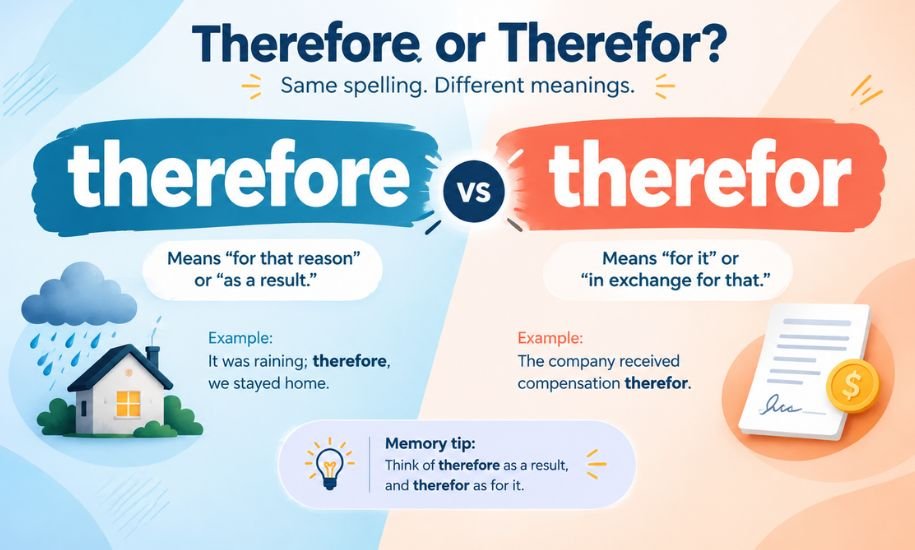
Have you ever wondered whether to write therefore or therefor? The two words look almost identical, with just one extra letter separating them, but they have different meanings. The confusion is understandable because both are legitimate English words. However, they cannot be used interchangeably. Therefore is the familiar word used to introduce a reasoned result or conclusion, while therefor is a much rarer term meaning “for it” or “in exchange for that”. Understanding this distinction will help you choose the right word in everyday, academic and formal writing.
Both therefore and therefor are correct English words, but they have different meanings. Therefore means “for that reason” or “as a result” and is used in ordinary writing. Therefor means “for it” or “in exchange for that” and is rare, particularly in British English.
Therefore or Therefor: What’s the Difference?
The main difference is what each word communicates. Therefore connects an idea to its logical consequence, whereas therefor refers to something previously mentioned.
| Feature | Therefore | Therefor |
|---|---|---|
| Correct spelling? | Yes | Yes |
| Part of speech | Adverb | Adverb |
| Meaning | For that reason; consequently | For it; in exchange for that |
| Common usage | Everyday and formal writing | Rare, often legal or formal contexts |
| Typical purpose | Introduces a result or conclusion | Refers back to something mentioned |
| Example | It was raining; therefore, we stayed home. | The company received payment therefor. |
For most everyday sentences, therefore is the appropriate choice. You would use therefor only when its specific meaning fits the context.
What Does Therefore Mean?
Therefore is an adverb meaning “for that reason”, “consequently” or “as a result”. It shows that one statement follows logically from another.
It is useful when explaining the outcome of an event, decision or situation. You will often find it in academic writing, professional communication, reports and everyday conversations.
For example:
- The weather was getting worse; therefore, the outdoor event was cancelled.
- She completed all the required training and was therefore eligible for the position.
- The shop was closed. Therefore, we decided to return the following morning.
- He had not submitted the application; therefore, his request could not be considered.
In each example, the word introduces a consequence or conclusion based on the information provided.
How to Use Therefore in a Sentence
You can place this word in different positions depending on the structure and flow of your sentence.
At the beginning:
Therefore, we decided to postpone the meeting until Monday.
In the middle:
The road was dangerous and therefore remained closed.
After a semicolon:
The train was delayed; therefore, several passengers arrived late.
After an independent clause:
She had completed the assignment and was therefore ready to submit it.
A useful grammatical point is that therefore is a conjunctive adverb. It connects related ideas, but it is not itself a coordinating conjunction such as and, but or so.
When it connects two independent clauses, a semicolon before it and a comma after it are appropriate:
The evidence was incomplete; therefore, the investigation continued.
You can also use a full stop before it:
The evidence was incomplete. Therefore, the investigation continued.
What Does Therefor Mean?
Therefor is also a real English word, but it is considerably less common. It means “for it”, “for that” or “in exchange for that”. The word refers to something already mentioned rather than introducing a logical consequence.
It is most likely to appear in legal documents, contracts and other formal writing.
For example:
- The company received compensation therefor.
- The agreement specifies the payment due therefor.
- The documents required therefor must accompany the application.
- The supplier issued a refund therefor.
- The organisation provided the equipment and received payment therefor.
In the first example, compensation therefor means compensation for something previously mentioned.
The word can sound unfamiliar because modern English usually expresses the same idea with simpler phrases such as “for it” or “in return for that”.
In British English, dictionaries commonly label this use archaic. However, it remains a recognised word, particularly in some American legal and formal contexts. It is not simply an incorrect version of therefore.
Therefore vs Therefor: Examples in Sentences
The easiest way to understand the difference is to compare the words in complete sentences.
| With therefore | With therefor |
|---|---|
| It was snowing; therefore, school was closed. | The contractor received payment therefor. |
| She was tired; therefore, she went to bed early. | The agreement outlined the compensation therefor. |
| He missed the deadline; therefore, his application was rejected. | The company received a refund therefor. |
| The evidence was unclear; therefore, the case required further investigation. | The documents required therefor were submitted. |
| They had no available seats and therefore waited outside. | The receipt issued therefor was kept safely. |
Notice how the words perform different functions. The first column explains a consequence, while the second refers to something for which payment, compensation or documentation is provided.
Correct and Incorrect Usage
Here are some additional examples to help avoid confusion.
Example 1
Correct: It was getting dark; therefore, we returned home.
Incorrect: It was getting dark; therefor, we returned home.
The sentence expresses a consequence, so therefore is required.
Example 2
Correct: The business received compensation therefor.
Incorrect for the intended meaning: The business received compensation therefore.
Here, therefor means compensation for something previously mentioned.
Example 3
Correct: She had completed the required work and was therefore entitled to payment.
Incorrect: She had completed the required work and was therefor entitled to payment.
The sentence needs the meaning “as a result”, making therefore the appropriate choice.
Synonyms of Therefore and Therefor
Both words have alternative expressions, although their synonyms depend on the intended meaning.
Common synonyms of therefore include:
- Consequently
- Thus
- Hence
- Accordingly
- As a result
- For that reason
- So
- In consequence
For example:
Original: The weather was poor; therefore, the match was postponed.
Alternative: The weather was poor; consequently, the match was postponed.
Possible alternatives to therefor include:
- For it
- For that
- In exchange for it
- In return for that
For example:
Original: The company received compensation therefor.
Simpler: The company received compensation for it.
These expressions are not perfect substitutes in every sentence, so choose one that preserves the intended meaning.
Therefore vs Thereby: Are They the Same?
Although therefore and thereby look similar, they have different meanings.
Therefore means “for that reason” or “as a result”. It introduces a conclusion or consequence.
Thereby means “by that means” or “by doing that”. It explains how an action produces a particular result.
Consider these examples:
- Therefore: The road was closed; therefore, we took another route.
- Thereby: She improved the process, thereby reducing the time required to complete the work.
The first sentence explains why another route was chosen. The second explains how improving the process reduced the time required.
Remember that these words are not interchangeable.
Frequently Asked Questions
1. Is therefor a real English word?
Yes. Therefor is a recognised English word meaning “for it” or “in exchange for that”. Although it is uncommon in modern British English, it still appears in some formal, contractual and legal contexts.
2. Is therefore always the correct choice?
No. Therefore is the appropriate choice when expressing a consequence or logical conclusion. However, therefor is correct when the intended meaning is “for it” or “in exchange for that”.
3. Is therefor a British or American spelling?
It is not a regional alternative spelling of therefore. Both words exist in British and American English, but therefor is generally labelled archaic in British dictionary usage and is more familiar in certain American legal expressions.
4. Can you start a sentence with therefore?
Yes. You can begin a sentence with therefore when introducing a conclusion based on an earlier statement. For example: “Therefore, we decided to change our plans.” A comma normally follows the word in this position.
5. What is the easiest synonym for therefore?
“As a result” and “for that reason” are two straightforward alternatives. Consequently, thus and hence are also useful, depending on the sentence and tone.
Final Verdict: Therefore or Therefor?
The choice depends on what you want to say. Use therefore when introducing a reason, result or conclusion. Use therefor when referring to something for which payment, compensation or another provision is made. Although both spellings are correct, the first is the natural choice in almost all everyday writing. Understanding this small but important distinction will help you write more accurately. At Grammar Stone, the aim is to make confusing English words easier to understand through clear explanations and practical examples.