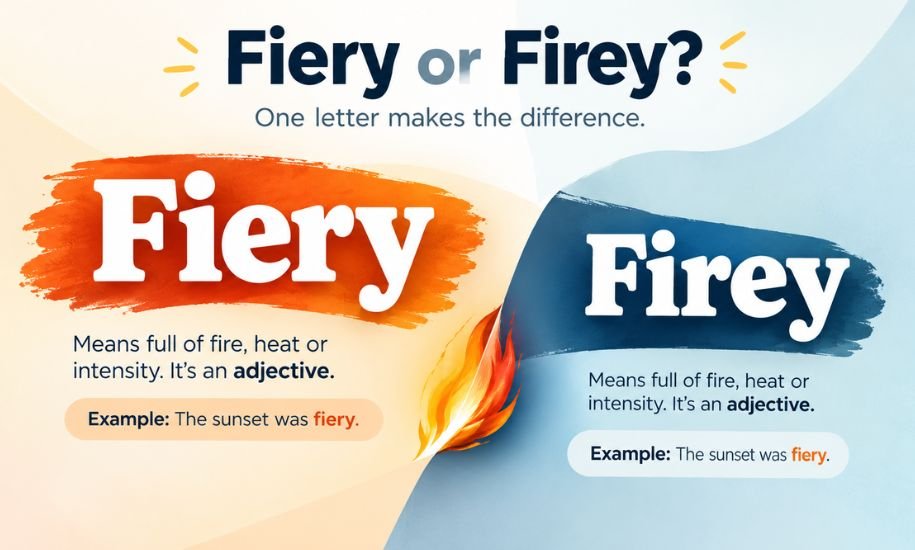
“Firey” and “fiery” look like they should be interchangeable, especially because fire + y seems like a natural way to form an adjective. However, standard English uses a different spelling: fiery. The confusion is understandable because the pronunciation does not make the spelling especially obvious, and the word has an unusual history. There is also a small regional twist: in Australian English, firey can be used informally as a noun for a firefighter. So while fiery is the form you normally need, “firey” is not quite as simple as calling it wrong in every context.
Fiery is the standard spelling of the adjective meaning like fire, very hot, spicy, passionate, or easily angered. Firey is normally a misspelling when used as that adjective. However, in Australian informal English, firey is also used as a noun meaning a firefighter.
Firey or Fiery: The Difference at a Glance
| Form | Standard use | Meaning |
|---|---|---|
| fiery | Yes | Like fire, hot, bright, spicy, passionate, or quick-tempered |
| firey | Usually no | Common misspelling of fiery |
| firey | Yes in Australian slang | An informal noun for a firefighter |
For ordinary English writing, especially in school, work, journalism, or formal communication, choose fiery when you need the adjective. Cambridge and Oxford both list fiery as the standard adjective.
What Does “Fiery” Mean?
Fiery is an adjective with several related meanings. It can describe something physically associated with fire, something that is very hot or spicy, or a person or situation marked by strong emotion.
1. Related to fire or a fire-like appearance
Something can be fiery when it looks like fire or has a bright, glowing appearance.
- The sky became fiery orange at sunset.
- The flames cast a fiery glow across the room.
- She had fiery red hair.
Oxford defines the word in this sense as looking like or consisting of fire, while Cambridge also uses it for bright red or fire-like appearances.
2. Hot or spicy
Fiery can also describe food or drink that produces a strong burning sensation.
- The curry had a fiery kick.
- He ordered a fiery chilli sauce.
- That pepper made the soup surprisingly fiery.
This meaning does not necessarily refer to actual flames. Instead, it describes the strong heat you experience when eating or drinking something spicy.
3. Passionate, intense, or emotional
The word is frequently used figuratively for strong feelings, energetic behaviour, or intense expression.
- She gave a fiery speech.
- The candidates had a fiery debate.
- He is known for his fiery temper.
Oxford specifically includes the senses of becoming angry easily and showing strong emotion, especially anger.
Why Is It “Fiery” and Not “Firey”?
This is the part that makes the spelling confusing.
At first glance, it seems logical to take fire and add -y:
fire + y = firey
But English spelling does not always preserve a modern root word exactly when a related word developed much earlier.
According to Etymonline, fiery dates back to the late 13th century and comes from Middle English fier plus the adjective-forming suffix -y. The spelling of fire itself developed over time, while fiery preserved an older spelling pattern. Etymonline notes that the modern spelling of fire did not fully replace Middle English fier until around the 1600s.
That history explains why the correct form can look surprising today.
So the useful rule is not:
“Add -y to fire and change the letters.”
Instead, simply remember that the standard adjective is:
fire → fiery
not:
fire → firey
The unusual spelling is historical rather than a random modern exception.
Is “Firey” a Real Word?
There is an important qualification here.
When firey is being used to mean like fire, hot, spicy, passionate, or quick-tempered, it is generally treated as a misspelling of fiery. Lexical references identify that adjective use as a misspelling.
However, firey has a separate informal use in Australian English.
In Australian colloquial speech, a firey can mean a firefighter, and the plural is fireys. This is a regional noun rather than an alternative spelling of the adjective fiery. The usage is also documented in Australian English references and historical examples.
For example:
- The fireys worked through the night to contain the blaze.
- A local firey spoke to reporters after the incident.
So it would be inaccurate to say that the spelling firey can never be correct. The key is what the word is doing in the sentence.
Correct Usage Examples
The easiest way to see the distinction is through examples.
Correct adjective
- The sunset looked fiery red.
- She has a fiery personality.
- The chef prepared a fiery curry.
- The politician delivered a fiery speech.
- He is famous for his fiery temper.
Incorrect adjective spelling
- The sunset looked firey red.
- She has a firey personality.
- The chef prepared a firey curry.
In all of those examples, fiery is the standard form.
Correct Australian noun
- The fireys arrived within minutes.
- A local firey helped evacuate the residents.
Here, the word refers to firefighters, so the Australian colloquial noun firey is appropriate in that regional context.
How Do You Pronounce “Fiery”?
The pronunciation can contribute to the spelling confusion.
Cambridge gives the pronunciation as approximately /ˈfaɪə.ri/ in both its UK and US entries. A simple learner-friendly approximation is:
FYE-uh-ree
It is normally pronounced with three syllables, which can make the relationship between fire and fiery less obvious to learners.
The important point is that pronunciation does not change the spelling. In standard adjective use, write fiery.
Fiery vs Fierce
Fiery and fierce can sometimes appear in similar contexts, but they are not interchangeable in every sentence.
Fiery often suggests passion, strong emotion, anger, heat, or intensity.
Fierce more often emphasizes aggression, force, severity, or determination.
Compare:
- She has a fiery temper.
- The two teams had a fierce rivalry.
A speech can be fiery because it is passionate and forceful. A competition can be fierce because the participants are highly aggressive or determined.
Fiery Synonyms by Meaning
The best synonym depends on the context.
When “fiery” means hot or burning
- blazing
- burning
- scorching
- glowing
- blazing-hot
When it means passionate or emotional
- passionate
- fervent
- ardent
- impassioned
- spirited
When it refers to anger or temperament
- hot-tempered
- hotheaded
- intense
- easily angered
When it describes spicy food
- hot
- spicy
- peppery
- pungent
Not every synonym works in every sentence. For example, spicy works naturally for food, while passionate may work for a speech or personality but not for the colour of a sunset.
Is There a British or American Spelling Difference?
No. Fiery is the standard spelling in both British and American English. Cambridge lists the same adjective spelling for both varieties.
So you should write:
- British English: fiery
- American English: fiery
This is not like colour/color or centre/center, where both forms are standard regional spellings.
The Australian situation is different because firey has a separate colloquial noun meaning firefighter. That does not make firey an alternative Australian spelling of the adjective fiery.
Common Mistakes to Avoid
Mistake 1: Writing “firey” because it looks logical
The spelling firey seems to follow the pattern of fire + y, but the established adjective is fiery.
Correct: a fiery sunset
Incorrect: a firey sunset
Mistake 2: Assuming fiery only means “on fire”
The word can also describe colour, spicy food, strong emotion, or a quick temper.
Mistake 3: Saying “firey” is never a real word
That misses the Australian noun use. In Australian colloquial English, firey can mean a firefighter.
Mistake 4: Treating fiery and fierce as exact synonyms
They overlap in some emotional contexts, but their meanings are not identical.
An Easy Way to Remember the Spelling
A useful memory trick is to remember:
Fiery has “ie,” not “ei.”
Think:
F-I-E-R-Y = fiery
You can also connect the unusual spelling with its history: the fier- part comes from an older form associated with fire, which helps explain why the word does not simply appear as firey.
Once you have seen fiery in phrases such as fiery speech, fiery temper, and fiery sunset, the spelling becomes much easier to recognize.
Frequently Asked Questions
Is it spelled firey or fiery?
For the standard adjective, the correct spelling is fiery. Use it when you mean something related to fire, very hot, spicy, passionate, intense, or quick-tempered.
Is “firey” a word?
It can be. As an adjective meaning “like fire,” it is generally a misspelling of fiery. In Australian colloquial English, however, firey is also used as a noun meaning a firefighter.
What does fiery mean?
Fiery can mean resembling fire, bright red, very hot, spicy, passionate, strongly emotional, or easily angered. Its exact meaning depends on context.
How do you pronounce fiery?
It is commonly pronounced approximately FYE-uh-ree, with the dictionary pronunciation represented as /ˈfaɪə.ri/.
Is fiery British or American English?
Both British and American English use fiery as the standard spelling. There is no British-versus-American spelling difference for this adjective.
What are some synonyms for fiery?
Depending on the context, useful alternatives include passionate, fervent, intense, hot-tempered, blazing, burning, spicy, and peppery. The best choice depends on what fiery means in the sentence.
Final Verdict: Firey or Fiery?
For almost every situation where you need the adjective, choose fiery. It is the standard spelling for something fire-like, hot, spicy, passionate, or intense, and it is used in both British and American English. Firey should normally be treated as a misspelling in that context, although Australian English uses firey informally for a firefighter. When in doubt, the safe standard choice is fiery—and that distinction is exactly the kind of practical English guidance Grammar Stone is here to provide.