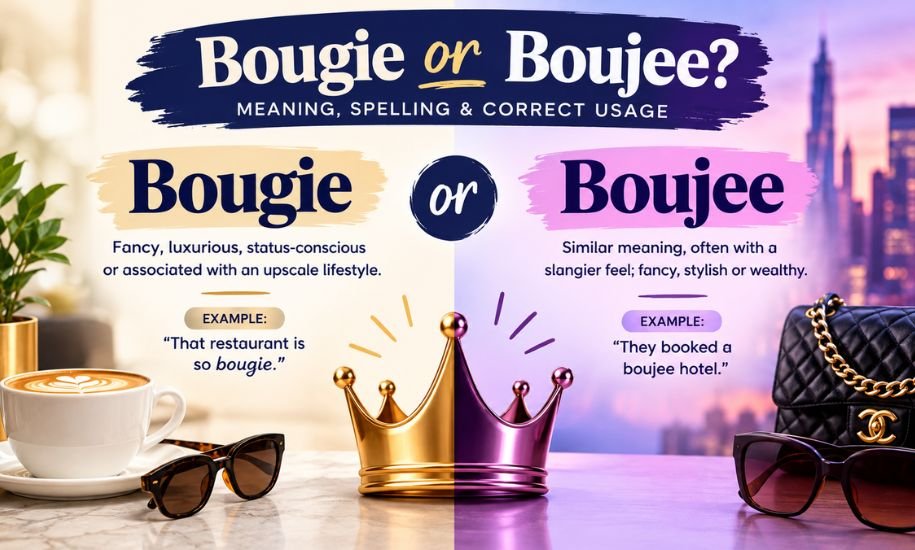
If you have seen both bougie and boujee, you may wonder whether one is a spelling mistake or whether the two forms have different meanings. The answer is a little more nuanced: both forms are used in modern English, but bougie is the more established spelling, while boujee is a recognized informal variant strongly associated with slang and pop culture. Their meanings overlap, although the tone can change depending on context. Understanding where the terms came from also helps explain why two spellings exist.
Bougie is the more established spelling, while boujee is a recognized informal variant. Both can describe something luxurious, fancy, expensive, or associated with an upscale lifestyle. For general writing, bougie is the safer choice; boujee often feels more casual, playful, or connected to pop culture.
Bougie vs. Boujee: What’s the Difference?
The main difference is not a strict difference in definition. In modern informal English, bougie and boujee frequently overlap.
Merriam-Webster treats boujee as a less common variant of bougie, while Dictionary.com also identifies boujee as a variation of bougie. This means it is inaccurate to treat boujee as nothing more than a spelling error.
| Feature | Bougie | Boujee |
|---|---|---|
| Status | Established spelling | Recognized informal variant |
| Meaning | Fancy, upscale, status-conscious, or luxurious | Similar meaning, often with a slangier feel |
| Register | Informal | Informal |
| Tone | Can be complimentary, playful, or critical | Can be complimentary, playful, or critical |
| Best general choice | Yes | More casual/stylized |
| Example | “That restaurant is a little bougie.” | “They booked a boujee hotel.” |
There is also no universal rule that bougie means “pretending to be rich” while boujee means “actually rich.” That distinction appears in some informal explanations, but major dictionary sources do not establish it as a fixed rule.
What Does “Bougie” Mean?
As slang, bougie usually describes someone or something associated with expensive tastes, comfort, social status, or an upscale lifestyle. It can suggest that a person is particularly concerned with money, class, appearance, or sophisticated consumer choices.
Cambridge classifies the slang sense as informal and disapproving, describing people or things associated with the middle class and a strong interest in money, education, social class, or expensive and unusual things.
The word can be negative, but it is not always an insult. Someone might jokingly describe a favourite café, expensive skincare product, hotel, or dinner as bougie simply because it feels luxurious.
Examples
- “This little café is surprisingly bougie.”
- “She has a bougie taste in home décor.”
- “We stayed at a beautiful but very bougie hotel.”
- “I know the brunch is bougie, but the food is excellent.”
The surrounding context tells you whether the speaker is praising the experience, teasing someone, or criticising unnecessary extravagance.
What Does “Boujee” Mean?
Boujee generally carries the same broad idea: something fancy, luxurious, stylish, or associated with wealth and indulgence.
Dictionary.com describes it as a variation of bougie and connects the spelling strongly with hip-hop slang and popular culture.
The spelling can give the word a more deliberately casual or playful appearance:
- “We had a boujee dinner downtown.”
- “Her new apartment is so boujee.”
- “He wants a boujee coffee machine.”
- “That resort looks ridiculously boujee.”
In other words, the extra “e” does not automatically create a completely new meaning. It is often simply the spelling chosen by the writer or speaker.
Which Spelling Should You Use?
For most general informal writing, bougie is the better default because it is the more established spelling in dictionaries.
Use bougie when you want a straightforward description in an article, explanation, or ordinary piece of prose:
“The hotel has a slightly bougie atmosphere.”
Use boujee when the spelling itself fits a highly casual, playful, musical, or pop-culture context:
“That brunch spot is boujee.”
You should also preserve boujee when it is part of an official title, quotation, username, brand name, or other original wording. For example, Bad and Boujee should retain its original spelling.
Where Did “Bougie” Come From?
The slang adjective bougie is connected to bourgeois, a word associated with the middle class and, more broadly, with social class, material concerns, and conventional respectability.
Dictionary.com traces the slang to a shortening and alteration of bourgeois, with evidence dating to the late 1960s and 1970s. Merriam-Webster likewise gives the slang adjective’s etymology as a formation from bourgeois.
The modern slang sense developed beyond the literal social-class meaning. It became a way of criticising people perceived as overly concerned with appearances, possessions, status, or moving into a more affluent social world.
That history explains why the word can still carry a hint of pretension, even when it is being used humorously.
The Cultural History Behind the Slang
The slang use of bougie has an important connection with African American English. Linguistic sources note that the term became especially established among African American speakers, where it could describe someone viewed as elitist, overly status-conscious, or disconnected from their roots.
Dictionary.com similarly discusses the word’s development within Black American cultural and linguistic contexts.
Over time, the expression spread into wider American popular culture. As it became more mainstream, its tone also broadened. Today, a speaker may use bougie to criticise pretentious behaviour, while another may use it affectionately to describe enjoying something expensive.
That shift is one reason a simple definition such as “rich” is not enough.
How “Bad and Boujee” Helped Popularize the Spelling
The spelling boujee became especially visible through the Migos song “Bad and Boujee,” released in the 2010s.
The song did not invent the underlying slang. Rather, it helped bring the boujee spelling and a more celebratory interpretation of the word to a much wider audience. Dictionary.com specifically identifies the 2016 song as a major moment in the popularity of this spelling, while its dictionary entry treats boujee as a variation of bougie.
This is why some people associate boujee more strongly with luxury, style, success, and self-made wealth than with the older, more critical sense of bougie.
Still, the meanings are not rigidly separated.
Two Different Meanings of “Bougie” You Should Know
There is an important detail that can cause confusion: not every use of the word “bougie” comes from the same linguistic origin.
The slang adjective discussed above comes from bourgeois.
But bougie is also an older noun borrowed through French. It can refer to a candle, and in medicine it refers to a slender instrument used in a body passage for purposes such as examination or dilation. Dictionary.com traces this sense to French bougie, ultimately associated with Bougie, the historical name of a city in Algeria that was known for its wax trade.
So these are separate histories:
bourgeois → slang bougie → boujee
and
Bougie, Algeria → French bougie (“candle”) → English bougie
The medical and candle-related senses have nothing to do with the modern slang meaning of “fancy” or “pretentious.”
How Do You Pronounce Bougie and Boujee?
Pronunciation can vary.
Cambridge gives the adjective bougie as approximately “BOO-zhee” in US English and “BOO-jee” in UK English. The noun has a slightly different pronunciation pattern in Cambridge’s entries.
Because boujee is an informal spelling, people may also pronounce it in different ways, although “BOO-jee” is a common approximation.
You do not need to change the spelling based on pronunciation alone.
Is “Bougie” a Compliment or an Insult?
It can be either.
The word often has a critical edge because of its history as a term for behaviour considered pretentious, overly materialistic, or overly concerned with social status. Cambridge labels its adjective sense as disapproving, and Merriam-Webster also notes a frequently disparaging sense.
But everyday speakers also use it in a light-hearted or positive way:
Complimentary:
“That is such a bougie hotel.”
Playful:
“I bought a bougie candle because I felt like treating myself.”
Critical:
“He has become too bougie for the old neighbourhood.”
The speaker’s relationship with the subject and the surrounding context matter more than the spelling.
Bougie, Bourgeois and Boogie: Don’t Mix Them Up
These words look or sound similar, but they are not interchangeable.
Bougie can be modern slang meaning fancy, upscale, or status-conscious. It also has separate noun meanings involving a candle and a medical instrument.
Bourgeois is the older word connected with the social class and the source of the slang adjective.
Boogie is a different word, commonly associated with dancing, music, or a rhythmic style of music.
So a sentence such as “That restaurant is very boogie” would not normally mean that the restaurant is luxurious or pretentious.
Common Mistakes to Avoid
One common mistake is claiming that boujee is simply wrong. It is a recognised informal variant, although bougie is the more established spelling.
Another mistake is assuming that the two spellings have completely different definitions. In actual usage, their meanings overlap considerably.
It is also misleading to say that bougie always means “fake rich.” The word can refer to genuine luxury, expensive tastes, social-class attitudes, or playful enjoyment of something upscale.
Finally, remember that the slang word is different from the older noun bougie used for a candle or a medical instrument.
Easy Way to Remember
A simple rule is:
Bougie = the established spelling.
Boujee = the informal variant.
Think of the extra “e” in boujee as a stylistic addition often associated with casual slang and pop culture. It does not automatically change the basic meaning.
Final Verdict: Bougie or Boujee?
Both spellings have a place in modern informal English, but bougie is the better general choice because it is the more established form. Boujee is a recognised variant that became especially prominent through contemporary slang and pop culture. The meanings overlap, and the intended tone—not simply the spelling—determines whether the word sounds complimentary, playful, or critical. For clear language guidance and word comparisons, Grammar Stone helps you choose the form that best fits the context.