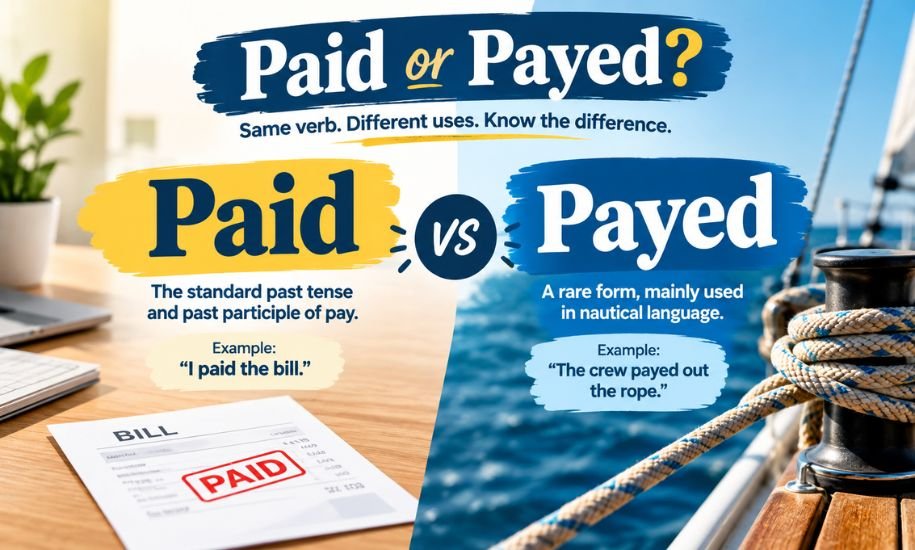
Paid and payed are easy to confuse because they look almost like two regular forms of the same verb. In ordinary English, however, paid is the form you need in almost every situation, including talking about money, wages, bills, attention, respect, and results. Payed does exist, but it has specialized uses, particularly in nautical language. The important point is that payed is not simply a casual alternative spelling of paid. Knowing what the sentence means makes the choice much easier.
Use paid for the normal past tense and past participle of pay: “I paid the bill,” “I got paid,” and “She paid attention.” Payed is a rare specialized form found mainly in nautical terminology. For everyday writing, paid is almost always the correct choice.
Paid or Payed: What’s the Difference?
Both paid and payed can be found in dictionaries, but they do not have the same everyday function.
Paid is the standard past tense and past participle of pay. It is used when someone gives money, receives money, settles an obligation, or uses expressions such as pay attention and pay respect. It can also appear in figurative expressions such as paid off.
Payed is much less common. It belongs to specialized nautical usage. Depending on the dictionary and the particular nautical meaning, it can refer to coating or sealing parts of a vessel, and it is also recorded in some references for letting out a rope or cable.
| Feature | Paid | Payed |
|---|---|---|
| Standard past tense of pay | Yes | No |
| Everyday English | Very common | Rare |
| Money, wages, bills | Yes | No |
| Paid attention | Yes | No |
| Paid off | Yes | No |
| Specialized nautical use | Sometimes | Yes, in specific uses |
The safest practical rule is simple: use paid unless you are dealing with a genuine specialized nautical meaning.
What Does “Paid” Mean?
Paid is the past simple and past participle of the irregular verb pay. Unlike regular verbs such as walk → walked, pay does not form its ordinary past tense by simply adding -ed. Its main forms are:
| Verb form | Example |
|---|---|
| Pay | I pay the bill every month. |
| Paid | I paid the bill yesterday. |
| Paid | I have paid the bill already. |
Cambridge Dictionary lists paid as both the past simple and past participle of pay.
The word is used in several situations:
- Money: She paid for the tickets.
- Wages: The company paid its workers on Friday.
- Bills and debts: We paid the electricity bill.
- Attention: He paid close attention to the instructions.
- Respect or tribute: They paid tribute to the retiring teacher.
- Results: Her hard work paid off.
This last group is important because paid is not limited to financial situations. English uses pay in established expressions where no money changes hands. Collins includes uses involving attention, compliments, respects, visits, returns, and other non-financial meanings.
Paid as an adjective
Paid can also work as an adjective:
- She found a paid internship.
- He is taking paid leave.
- The invoice has been marked paid.
So the word can describe something that has been compensated for or settled, not just an action in the past.
Is “Payed” a Real Word?
Yes, but this is where the confusion begins.
Payed is not merely a misspelling that never exists. It is a legitimate but rare form used in specialized maritime language. Collins records a nautical meaning in which payed relates to allowing a vessel to move to leeward, as well as a separate nautical verb meaning to cover a wooden vessel’s seams with pitch or tar.
Scribbr also records payed for certain maritime uses involving coating a vessel and letting out a rope or chain.
There is an important nuance here: dictionary treatment of pay out involving a rope or cable is not completely uniform. Cambridge gives paid as the past form of pay out when it means releasing rope or cable in a controlled way.
Because of that variation, it is better not to teach an absolute rule such as “ropes always take payed.” In ordinary writing, paid is the safe choice. In technical nautical writing, follow the terminology and style used by the relevant maritime source.
Paid Attention or Payed Attention?
The correct expression is paid attention.
Correct: She paid attention during the lesson.
Incorrect: She payed attention during the lesson.
The phrase pay attention means to concentrate, listen carefully, or notice something. Its past form is therefore paid attention, because paid is the normal past form of pay.
More examples:
- Please pay attention to the warning.
- I paid attention to every instruction.
- He wasn’t paying attention when the announcement was made.
- The students paid close attention to the experiment.
The same principle applies to expressions such as paid respect, paid tribute, and paid a visit. The meaning does not have to involve money for the established past form to remain paid.
“I Got Paid” or “I Got Payed”?
The standard expression is I got paid.
Correct: I got paid yesterday.
Incorrect: I got payed yesterday.
Here, got paid is a passive construction meaning that someone received money, usually wages, a fee, or another form of compensation.
Examples:
- I got paid at the end of the month.
- She got paid for the extra hours she worked.
- We finally got paid for the project.
- He hasn’t got paid yet.
Because the sentence concerns receiving money, payed has no place in standard everyday English.
Paid a Bill or Payed a Bill?
Use paid a bill.
Correct: I paid the bill this morning.
Incorrect: I payed the bill this morning.
The same spelling applies to common financial expressions:
- paid the rent
- paid the invoice
- paid the fee
- paid the debt
- paid the tax
- paid the balance
You can also use paid for when explaining what someone purchased or what a payment covered:
- We paid for dinner.
- She paid for the repairs.
- I paid for the tickets online.
Cambridge lists patterns such as pay for something, pay someone, and pay something, while identifying paid as the past form.
Paid Off or Payed Off?
The correct everyday expression is paid off.
It has two especially common meanings.
A debt was completely repaid
- They paid off the loan.
- She has paid off her credit card debt.
An effort produced a successful result
- His hard work paid off.
- All the extra practice paid off in the final match.
Cambridge lists paid off for both repaying money and achieving a successful result.
So:
Correct: Her hard work paid off.
Incorrect: Her hard work payed off.
“Paid for” vs “Paid”: How Are They Used?
One useful distinction is the grammar that follows the verb.
Use paid + object when the object is the thing being paid:
- I paid the bill.
- She paid the driver.
- We paid the company.
Use paid for + thing when you are identifying what the payment was for:
- I paid for the meal.
- She paid for the course.
- They paid for the repairs.
You can also say:
- The business paid me for the work.
- He paid her for the design.
These patterns are standard uses of pay rather than different spellings of the verb.
Common Mistakes With Paid and Payed
The most frequent mistake is treating pay as though it were a regular verb.
Wrong: I payed the rent.
Right: I paid the rent.
Wrong: She has payed the invoice.
Right: She has paid the invoice.
Wrong: I got payed yesterday.
Right: I got paid yesterday.
Wrong: He payed attention to the instructions.
Right: He paid attention to the instructions.
There is another related mistake involving did.
Wrong: Did you paid the bill?
Right: Did you pay the bill?
After the auxiliary did, the main verb returns to its base form:
- Did you pay?
- I did not pay.
- When did she pay?
You do not use paid after did because the past tense is already carried by the auxiliary.
Paid or Payed in British and American English
For ordinary English, paid is the standard form in both British and American English. This is not a case like colour/color, where the preferred spelling changes by region. Cambridge’s UK and US entries both identify paid as the past form of pay.
Therefore, whether you are writing for a British or American audience, use:
- paid the bill
- paid for the meal
- got paid
- paid attention
- paid off the debt
Regional differences do not turn these ordinary uses into payed.
Synonyms for “Paid” Depend on the Context
There is no single synonym that works in every sentence. The best alternative depends on what paid means.
| Meaning | Possible alternative |
|---|---|
| Paid a bill | settled |
| Paid a debt | repaid |
| Paid an employee | compensated |
| Paid someone back | reimbursed / repaid |
| Paid for something | covered the cost |
| Paid attention | concentrated / took notice |
| Paid tribute | honoured |
These are not perfect replacements in every sentence. For example, settled can work for a bill but cannot naturally replace paid attention. Choosing a synonym therefore requires looking at the meaning, not just the spelling.
How to Remember the Difference
Think of paid as the normal past form of pay:
pay → paid → paid
That covers ordinary uses involving money and a wide range of expressions such as paid attention and paid off.
For payed, remember one additional idea:
specialized nautical language
That is a better memory rule than trying to associate payed with every rope or cable sentence, because dictionary treatment of particular nautical constructions can vary.
A quick practice test
Choose paid, payed, or pay:
- I ___ the electricity bill yesterday.
- She ___ attention to the announcement.
- Did you ___ for the tickets?
- His extra effort finally ___ off.
- The sailors ___ out the line according to the vessel’s technical procedure.
Answers:
- paid
- paid
- pay
- paid
- payed may be used in specialized nautical terminology, depending on the technical usage and style guide; paid is also used for pay out in dictionaries such as Cambridge.
Frequently Asked Questions
Is “payed” ever correct?
Yes. Payed is a real but uncommon word associated with specialized nautical meanings. It should not be used as the normal past tense of pay in everyday English.
Is “paid” the past tense of “pay”?
Yes. Paid is both the standard simple past and the past participle of pay: I paid yesterday and I have paid already.
Is it “paid attention” or “payed attention”?
It is paid attention. The expression uses the ordinary verb pay, whose past form is paid.
Should I write “I got paid” or “I got payed”?
Write I got paid when you mean that you received money for work, services, or another payment.
Is “paid off” correct?
Yes. Paid off is correct in ordinary English. It can describe completely repaying a debt or achieving a successful result after effort.
Is “paid” correct in both British and American English?
Yes. Paid is the standard spelling for ordinary uses of pay in both varieties. There is no ordinary British-versus-American spelling difference here.
Final Verdict: Paid or Payed?
For nearly every sentence you write in everyday English, choose paid. It is the standard past tense and past participle of pay, whether you are talking about a bill, wages, a purchase, attention, respect, or an effort that succeeded. Payed is a rare specialized form, mainly associated with nautical terminology, so it should only appear when that technical meaning genuinely applies. For clear and accurate word choices, Grammar Stone helps you understand the difference and use the right form with confidence.