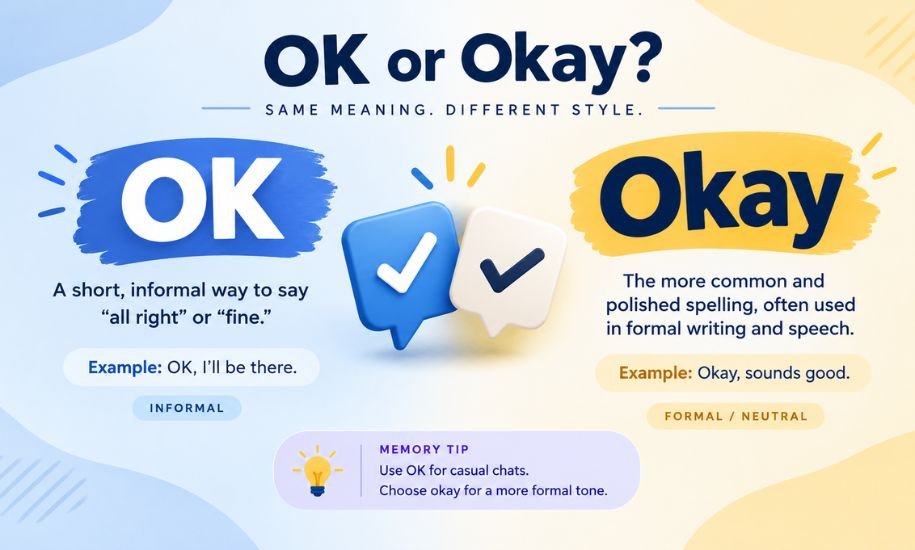
“OK” and “okay” often appear in the same sentence types, so it is natural to wonder whether one is correct and the other is a mistake. The good news is that you do not have to choose between a correct word and an incorrect one: both forms are established English spellings. They generally have the same meaning, but writers may choose one based on style, context, consistency, or an organisation’s style guide. The question becomes more interesting in formal writing, where a precise alternative may sometimes be better.
Both OK and okay are correct. They are alternative spellings of the same word and usually mean “all right,” “acceptable,” or “agreed.” Use the form preferred by your style guide, and in very formal writing, consider a more precise word when appropriate.
OK or Okay: Which Is Correct?
Both OK and okay are standard forms. Cambridge Dictionary describes okay as also spelled OK and shows both forms functioning as a discourse marker, adjective, and adverb. Other major usage references likewise treat the two as alternative spellings rather than separate words with different core meanings.
For example:
- OK, I’ll call you later.
- Okay, I’ll call you later.
Both sentences are correct.
Likewise:
- Is it OK if I leave early?
- Is it okay if I leave early?
Again, the meaning is essentially the same.
Quick comparison
| Feature | OK | okay |
|---|---|---|
| Correct spelling? | Yes | Yes |
| Basic meaning | All right; acceptable; agreed | All right; acceptable; agreed |
| Common use | Conversation, prose, signs, instructions | Conversation, prose, dialogue |
| Formality | Depends on the style guide | Depends on the style guide |
| Lowercase form | ok is common informally | Not applicable |
| Example | The plan is OK. | The plan is okay. |
The important distinction is not correct versus incorrect. It is mainly a matter of editorial preference and context.
What Does “OK” Mean?
OK can mean “all right,” “acceptable,” “satisfactory,” or “approved.” It can also express agreement or signal that a speaker is moving to a new point. Cambridge documents several of these uses, including adjective, adverb, noun, verb, and interjectional uses.
Examples:
- Are you OK after the journey?
- The report looks OK to me.
- OK, let’s begin.
- We need the manager’s OK before we proceed.
- The editor OK’d the changes.
In the first two examples, it describes a condition or quality. In the third, it introduces a statement or signals agreement. In the fourth, it is a noun meaning approval. In the fifth, it functions as a verb meaning to approve or authorize.
What Does “Okay” Mean?
Okay carries essentially the same meanings as OK. It can describe something as satisfactory or acceptable, show that someone is safe or well, ask for permission, or express agreement.
Examples:
- Is everything okay?
- The food was okay, but not excellent.
- Okay, I understand.
- Is it okay to open the window?
- She gave us the okay to continue.
Cambridge also records okay as an adjective and adverb and uses it in everyday expressions for agreement, health, permission, and satisfactory conditions.
In most ordinary sentences, you can replace one form with the other without changing the message:
Everything is OK.
Everything is okay.
The difference is primarily stylistic.
Is OK or Okay More Formal?
This is where a simple answer such as “okay is formal and OK is informal” can become misleading. There is no universal rule that makes one spelling the formally correct choice. Different style authorities make different recommendations.
For example, the Associated Press style used in journalism prefers OK and gives forms such as OK’d and OKs, while Chicago-related guidance does not treat okay as an error. Microsoft’s writing guidance also uses OK in its style conventions.
At the same time, the Language Portal of Canada takes a stricter view for formal writing: it classifies OK, O.K., and okay as informal and recommends more precise alternatives such as acceptable, approval, authorize, or satisfactory.
So, is OK or okay formal? The answer depends on the style and purpose of the document.
For highly formal writing, these alternatives may be more precise:
- OK → acceptable
- OK → approved
- okay → satisfactory
- okay → permitted
- the OK → approval
Compare:
Is it okay to submit the form tomorrow?
with:
Is it acceptable to submit the form tomorrow?
The second sentence sounds more formal because acceptable states the intended meaning more precisely. That does not make okay grammatically wrong.
OK or Okay in Writing
For ordinary writing, either form can work. The safest general rule is to choose one spelling and use it consistently, unless a quotation, fixed expression, or specific style requirement calls for another form. QuillBot explicitly recommends consistency and checking the relevant style guide when one applies.
For example, this is fine:
Okay, I’ll send the revised version this afternoon.
This is also fine:
OK, I’ll send the revised version this afternoon.
A polished article, report, or website does not need to alternate between the two merely to avoid repetition. Consistency makes edited writing look intentional.
OK or Okay in Email
Both forms can be natural in everyday and professional emails:
OK, I’ll review the document today.
Okay, I’ll review the document today.
However, the best professional wording may depend on what you actually mean. When OK means approval, a precise noun can be clearer:
We need your approval before we publish the report.
When okay simply means acceptable, use acceptable or satisfactory when the tone calls for greater formality.
For a quick internal email, “OK” or “okay” is usually unremarkable. For a formal letter, policy, contract, or official document, consider whether a more exact word would communicate the decision more clearly.
Is OK or Okay Different in UK English?
There is no simple rule that says British English must use okay while American English must use OK. Both forms are used in British English, and Cambridge’s British-English grammar reference treats okay and OK as alternative spellings.
So these are both acceptable:
Are you OK?
Are you okay?
The better choice is usually the one required by the publication, employer, school, or house style you are following.
Which Came First: OK or Okay?
OK came first. Oxford University Press traces the first known printed use to the Boston Morning Post on March 23, 1839, where it appeared as a joking abbreviation of “oll korrect,” a humorous misspelling of “all correct.”
The expression survived long after the newspaper joke that created it had disappeared. The spelling okay developed later as a full written form of the same expression.
This history explains why okay should not be treated as a correction of OK. They are two established written forms of the same word.
OK or Okay: Examples in Sentences
Seeing the two forms side by side makes the relationship clearer.
Agreement
OK, I’ll join you at six.
Okay, I’ll join you at six.
Permission
Is it OK to park here?
Is it okay to park here?
Condition or health
Are you OK?
Are you okay?
Satisfactory quality
The results were OK.
The results were okay.
Approval
We got the manager’s OK.
We got the manager’s okay.
In each pair, the basic meaning stays the same. The choice is about preferred form and context rather than a difference in grammar.
What About “ok” and “O.K.”?
You may also see ok in lowercase, especially in casual digital communication. QuillBot describes it as a less common variant and recommends OK or okay for standard polished writing.
The dotted form O.K. is also encountered, particularly in older texts or publications with a specific house style. Modern edited English generally makes OK the simpler choice, although style guides differ.
So, as a practical guide:
- OK — standard modern form
- okay — standard alternative spelling
- ok — common informal lowercase form
- O.K. — older or style-specific form
OK or Okay Synonyms: Which Word Fits Best?
The best synonym depends on the meaning you intend. OK and okay are flexible words, so replacing them with a more exact term can make a sentence clearer.
| Meaning | Useful alternatives |
|---|---|
| Acceptable | acceptable, satisfactory |
| Permission | permission, authorization |
| Approval | approval, consent |
| All right | fine, all right |
| Approved | authorized, approved |
| Agreement | yes, agreed, certainly |
For instance:
The proposal is okay.
could mean merely that it is acceptable. In a formal report, The proposal is satisfactory may be more informative.
Likewise:
We need the OK from the director.
could become:
We need the director’s approval.
The second version removes ambiguity about what “OK” means.
Common Mistakes to Avoid
Treating “OK” as incorrect
OK is not a misspelling of okay. Both are established forms.
Assuming “okay” is always more formal
There is no universal rule supporting that claim. Some style guides prefer OK, while other formal-writing guidance recommends avoiding both forms in favour of a more precise word.
Using lowercase “ok” in every context
Lowercase ok is normal in informal communication, but it may look too casual in carefully edited prose.
Switching randomly between forms
Changing between OK and okay without a reason is not necessarily grammatically wrong, but consistency is usually better in edited writing.
Using “okay” when a precise word is available
In formal documents, acceptable, approved, authorized, or satisfactory may tell the reader exactly what you mean rather than relying on a broad conversational term.
An Easy Way to Remember
Think of OK and okay as two spellings of the same word, not two competing words.
OK = shorter form
okay = fully spelled-out form
Then remember the practical rule:
Follow the style guide, match the context, and stay consistent.
That rule works better than trying to memorize one spelling as universally correct.
Frequently Asked Questions
Is OK or okay correct?
Both OK and okay are correct spellings. They have the same basic meaning and can usually be used interchangeably. The preferred form depends on the context and, in edited work, the style guide being followed.
Is “ok” a real word?
Yes, lowercase ok is used as a variant, especially in informal digital communication. However, OK and okay are the more conventional forms for polished writing.
Is okay more formal than OK?
Not universally. Some writers may perceive okay as more conversationally spelled out, but style guides can prefer either form. For highly formal writing, replacing both with a precise term may be the better choice.
Can I use OK in a formal email?
Yes, depending on the style you are using. A formal email may still use OK, but when you mean approval or acceptance, a more specific expression such as approval or acceptable can sound clearer and more professional.
Is OK British or American English?
Both OK and okay are used in British and American English. The choice is not a simple US-versus-UK spelling difference. Cambridge records both forms in its British-English grammar guidance.
Which came first, OK or okay?
OK came first. Oxford University Press identifies a March 23, 1839, use in the Boston Morning Post, where it was explained as a humorous shortening of “oll korrect,” meaning “all correct.”
Final Verdict: OK or Okay?
OK and okay are both correct. Neither is simply the “right” form while the other is wrong. Use the spelling that fits your publication or style guide, keep it consistent, and choose a more precise word such as acceptable, approved, or satisfactory when formal writing calls for greater clarity. Grammar Stone follows the same practical principle: know the difference, then use the right words for the context.