Choosing between that and which can be confusing because both words can introduce a relative clause referring to a thing. The key is to decide whether the information is necessary to identify the noun or simply adds extra detail. Punctuation can help, too: a restrictive clause normally appears without commas, while a nonrestrictive clause is set off by commas. British English also allows some uses of which that traditional American style usually reserves for that.
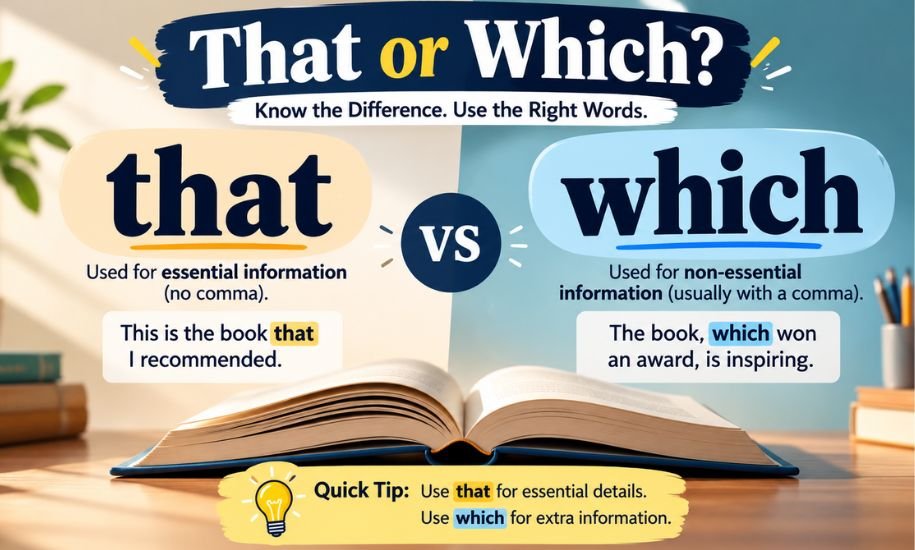
Both that and which are correct. In traditional American-style writing, use that for a restrictive clause that identifies exactly which person or thing you mean, and use which for a nonrestrictive clause that adds extra information and takes commas. In British English, restrictive which is also widely accepted.
The Main Difference Between That and Which
The simplest way to choose is to look at the job the relative clause is doing.
A restrictive relative clause is necessary to identify the noun. Without it, the sentence may become unclear or change meaning. In traditional American usage, that is the usual choice for things in this type of clause.
A nonrestrictive relative clause gives additional information. The sentence still identifies the noun without that extra clause, so the clause is separated with commas and normally introduced by which.
Compare:
- The jacket that has the silver buttons is mine.
- My jacket, which has silver buttons, is mine.
In the first sentence, the clause helps identify the jacket. In the second, the jacket has already been identified, and the information about the buttons is simply additional.
Quick comparison
| Feature | That | Which |
|---|---|---|
| Refers to things | Yes | Yes |
| Restrictive clause | Common choice | Also accepted, especially in British English |
| Nonrestrictive clause | No in standard formal usage | Yes |
| Usually follows a comma | No | Yes |
| Can refer to a whole preceding clause | No | Yes |
| Can follow a preposition directly | No | Yes |
When to Use “That”
Use that when the following clause is needed to identify or limit the noun.
Examples:
- The laptop that I ordered arrived today.
- She returned the shoes that were too small.
- We chose the hotel that had the best location.
- The recipe that you recommended was easy to follow.
In each example, the relative clause helps tell the reader which laptop, shoes, hotel, or recipe is meant.
For formal American English, this is the clearest default:
that + restrictive clause, usually without commas
That can also refer to people
Although who is generally preferred for people, that can be used in a defining or restrictive relative clause:
- The teacher that helped me was very patient.
- She is the person that I spoke to.
British Council and Cambridge both recognize this use, with Cambridge noting that that is more informal than who, whom, or which.
When to Use “Which”
Use which when the relative clause provides extra information rather than identifying the noun.
These clauses are called nonrestrictive or nonessential clauses and are normally surrounded by commas.
Examples:
- My bicycle, which I bought last year, is still in excellent condition.
- The museum, which opened in 1925, attracts thousands of visitors.
- Her new phone, which has a larger screen, is easier to use.
Remove the clause and the core sentence still works:
My bicycle is still in excellent condition.
That is a good sign that the clause is nonrestrictive.
Grammarly describes restrictive clauses as essential to the meaning and nonrestrictive clauses as additional information, which is a useful practical distinction for choosing the right construction.
That or Which After a Comma
This is one of the easiest parts of the rule to remember.
In standard formal usage, a nonrestrictive clause introduced after a comma takes which, not that.
Correct
The conference, which lasted three days, was extremely useful.
Incorrect
The conference, that lasted three days, was extremely useful.
The word that is not normally used to introduce a nonrestrictive relative clause. Cambridge specifically describes that as a relative pronoun for defining clauses only.
So when you see this pattern:
noun + , + ___ + extra information
the answer is normally which.
Can “Which” Be Used Without a Comma?
Yes. This is where the rule needs a little more nuance.
In British English, which can introduce a restrictive clause without commas:
The book which I borrowed was fascinating.
This means the particular book being discussed is the one that was borrowed.
The British Council gives examples in which either which or that can introduce defining clauses referring to things. Cambridge also explicitly lists which for both defining and non-defining clauses.
Traditional American editorial style is generally stricter and prefers that for restrictive clauses and which for nonrestrictive ones. The Chicago Manual of Style also acknowledges that restrictive which occurs, particularly in British English, so saying that which without a comma is always wrong would be too broad.
A useful regional example
American-style preference:
The report that explains the problem is on my desk.
British English:
The report which explains the problem is on my desk.
Both can be acceptable, but the first is the safer choice if you are following traditional American formal style.
What Happens to the Meaning?
The comma can change how the reader interprets the sentence.
Compare these two:
The employees who work remotely receive a travel allowance.
This suggests that only the employees who work remotely receive the allowance. The clause identifies a particular group.
The employees, who work remotely, receive a travel allowance.
Here, the sentence presents the employees as already identified and adds the information that they work remotely.
The difference is not merely punctuation. It affects the scope and meaning of the sentence.
That or Which in a Sentence: More Examples
Here are several side-by-side examples.
Example 1: Identifying information
The restaurant that serves breakfast opens at 7 a.m.
The clause identifies which restaurant.
Example 2: Extra information
The restaurant, which serves breakfast, opens at 7 a.m.
The restaurant is already identified; the breakfast detail is additional.
Example 3: Object of the verb
The film that we watched last night was excellent.
You can also omit that:
The film we watched last night was excellent.
The relative pronoun is the object of watched.
Example 4: Subject of the clause
The film that won three awards became a classic.
Here, that is the subject of won, so it cannot simply be removed:
The film won three awards became a classic. — Incorrect.
Cambridge and British Council both explain that a relative pronoun can often be omitted when it functions as the object, but not when it is the subject.
When “Which” Refers to a Whole Idea
There is one especially useful case where which has a broader meaning.
Consider:
The flight was cancelled, which caused a lot of confusion.
Here, which refers to the preceding situation—the cancellation of the flight—not simply to one noun.
Another example:
She forgot the meeting, which surprised everyone.
The which clause comments on the preceding event or idea.
Cambridge notes that which is used to introduce a relative clause when it refers to a whole preceding sentence or clause.
Using That and Which After Prepositions
This is another area where the two forms behave differently.
You can place a preposition directly before which:
The office in which she works is downtown.
That structure is grammatical and relatively formal.
You cannot normally put a preposition directly before that:
The office in that she works… — Incorrect.
Instead, move the preposition to the end:
The office that she works in is downtown.
Cambridge specifically distinguishes which from that in this construction.
There are therefore two common versions:
More formal:
The building in which they met is historic.
More conversational:
The building that they met in is historic.
That After Superlatives
After words such as best, biggest, first, last, and similar superlative or ranking expressions, that is often a natural choice:
- It was the best concert that I had ever attended.
- She is the first person that arrived.
- This is the most useful guide that I have found.
Cambridge specifically notes that that is often used after superlatives.
This does not mean that is the only grammatical possibility in every sentence, but it is a common and natural pattern.
Common Mistakes
1. Putting “that” after a comma
Incorrect: The car, that I bought yesterday, is outside.
Better: The car, which I bought yesterday, is outside.
2. Assuming “which” is always wrong without a comma
That rule is too absolute. Restrictive which is accepted in British English and occurs in other varieties of English as well.
3. Removing a subject relative pronoun
Incorrect: The phone that has a cracked screen is mine.
You cannot simply write:
The phone has a cracked screen is mine.
Here, that is the subject of the relative clause.
4. Using “which” for a person
In standard usage, which is normally used for things and animals, not people.
Better: The woman who called me left a message.
Possible: The woman that called me left a message.
Not standard: The woman which called me left a message.
British Council and Cambridge both distinguish who for people from which for things.
5. Treating the American rule as universal English
Style conventions vary by region. A rule that is strongly preferred in formal American writing may be more flexible in British English. Keeping the intended audience in mind prevents unnecessary corrections.
An Easy Way to Remember the Difference
Use this two-question test:
1. Does the clause tell me which person or thing I mean?
Use that in traditional American formal writing, without commas.
2. Is the clause simply adding information?
Use which, with commas.
For example:
The keys that are on the kitchen counter are mine.
Which keys? The ones on the counter.
My keys, which are on the kitchen counter, are missing.
The keys are already identified; their location is extra information.
For British English, remember one additional point: which can also be used for a restrictive clause when there are no commas.
Practice: Choose That or Which
Try these sentences before checking the answers.
- The book ___ I bought yesterday is already damaged.
- My laptop, ___ I purchased in June, is still under warranty.
- The road ___ leads to the village is closed.
- The village, ___ lies near the coast, attracts many visitors.
- The movie was delayed, ___ meant we missed the last train.
Answers
- that — restrictive clause
- which — nonrestrictive clause
- that — restrictive clause
- which — nonrestrictive clause
- which — refers to the whole preceding situation
In British English, which could also appear in some defining examples such as “The book which I bought yesterday…”, although that is the traditional American-style preference.
FAQs
Is “that or which” a choice between two correct words?
Yes. Both are legitimate relative pronouns. The choice depends mainly on whether the clause is restrictive or nonrestrictive, along with regional style conventions.
Should I use “that” or “which” after a comma?
Use which for a standard nonrestrictive relative clause. That is not normally used to introduce a comma-separated nonrestrictive clause.
Is “which” without a comma grammatically correct?
Yes, particularly in British English. For example, “The car which I bought is outside” is standard British usage. Traditional American formal style generally prefers that for this restrictive construction.
Can “that” refer to people?
Yes. That can refer to people in defining relative clauses, although who is generally the more natural choice, especially in more formal writing.
Can I leave out “that” or “which”?
Often, yes, when the relative pronoun is the object of the clause: “The book that I borrowed” can become “The book I borrowed.” You normally cannot omit it when it is the subject: “The book that fell” cannot become “The book fell” with the same relative-clause meaning.
Final Verdict: That or Which?
Both that and which are correct; the important distinction is how the relative clause functions. Use that as the traditional choice for a restrictive clause in American-style formal writing, and which for a nonrestrictive clause set off by commas. British English allows which in restrictive clauses as well. Once you focus on whether the information identifies the noun or merely adds detail, the choice becomes much easier. For clear, accurate grammar guidance, Grammar Stone keeps the rule practical rather than treating regional conventions as absolute.