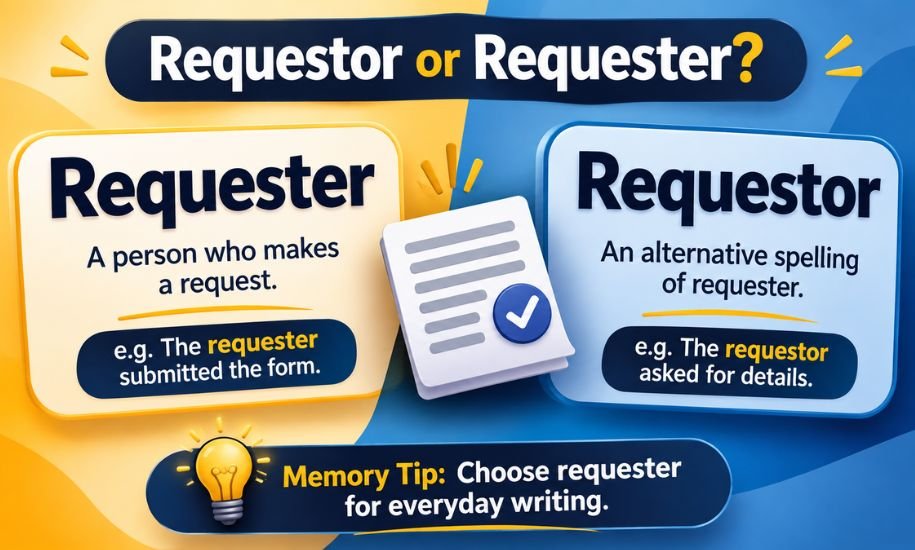
When writing about someone who asks for information, assistance or permission, should you use requestor or requester? Both spellings are recognised in English, and they have the same basic meaning. However, one is considerably more common in everyday writing. Understanding how dictionaries treat these alternatives, where each spelling appears and how they relate to words such as requestee will help you choose the most appropriate form.
Both requester and requestor are correct spellings. They describe a person or organisation that makes a request. However, requester is the more common choice and is generally preferable in everyday and British English writing. Use requestor when it is the established spelling in a particular organisation, document or technical context.
Requester vs Requestor: What’s the Difference?
The main difference is spelling rather than meaning. Both words identify someone who asks for something, whether it is information, assistance, permission or access to a service.
| Feature | Requester | Requestor |
|---|---|---|
| Correct spelling? | Yes | Yes |
| Meaning | Someone who makes a request | Someone who makes a request |
| Part of speech | Noun | Noun |
| Usage | More common | Less common |
| British English | Preferred general choice | Recognised alternative |
| Pronunciation | ri-KWES-ter | Generally the same |
Cambridge Dictionary recognises requestor as an alternative spelling of requester. Collins also lists it but describes it as a rare spelling. Therefore, neither form is automatically incorrect, although requester is the safer choice for most general writing.
What Does Requester Mean?
A requester is a person, organisation or other entity that asks for something. The request might involve obtaining a document, receiving information, accessing a service or seeking permission.
It is a noun formed from the verb request. The word is particularly useful in formal, administrative and professional communication.
Examples:
- The requester submitted an application for access to the public records.
- We contacted the requester to obtain some additional information.
- Each requester must provide a valid email address.
- The council sent a confirmation message to the requester.
- The requester received the documents within the agreed timeframe.
In these examples, the person making the request is the requester. The word works naturally in both everyday and formal writing.
What Does Requestor Mean?
Requestor is an alternative spelling of requester. It has the same meaning and grammatical function, although it appears less frequently in general English.
You may encounter this version in administrative documents, legal terminology, software systems and organisational guidelines. Some institutions or technical platforms retain it as their preferred spelling.
Examples:
- The requestor must complete the required application form.
- The system records the requestor’s details automatically.
- The requestor asked for access to the restricted documents.
- The department notified the requestor about the decision.
These sentences are grammatically acceptable. However, there is no general rule requiring legal or technical writers to use this spelling. Both alternatives appear in formal contexts.
Is Requester or Requestor Preferred in UK English?
For British English, requester is the recommended general-purpose choice.
Collins identifies requestor as a rare British English spelling, while Cambridge recognises it as an alternative. This means British writers can encounter both versions, but the conventional -er ending makes requester the more suitable option for ordinary communication.
Official usage provides a useful example. The UK’s Information Commissioner’s Office (ICO) regularly uses requester in its Freedom of Information guidance when referring to an individual or organisation asking for information.
American English also recognises both spellings. The distinction is therefore not simply British versus American: requester is suitable in both varieties, while requestor remains an accepted alternative.
For consistency, choose one spelling throughout a document rather than switching between the two without a reason.
Requester vs Requestee: Are They Different?
Although they look similar, requester and requestee describe different roles.
A requester is the person making a request, whereas a requestee is the person being asked to do something.
Consider this example:
Sarah emails Daniel and asks him to send her a copy of a report.
- Sarah is the requester because she makes the request.
- Daniel is the requestee because he receives the request.
The word requestee is relatively uncommon, but it can be useful when discussing both sides of a formal request.
It is also important not to confuse a requestee with an approver. An approver is someone who has the authority to accept or reject a request. That responsibility may belong to the requestee, but it does not have to.
Requester Synonyms and Related Words
Several words can describe someone who asks for something, but their suitability depends on the situation.
| Alternative | Meaning or typical context |
|---|---|
| Applicant | Someone applying for a position, service or benefit |
| Petitioner | Someone submitting a formal petition |
| Claimant | Someone making a claim or seeking an entitlement |
| Submitter | Someone who submits a document or form |
| Requesting party | A formal expression for the person or organisation making a request |
These alternatives are not always interchangeable. For example, applicant usually suggests a formal application, while petitioner has a more specific formal meaning.
There is no universally accepted direct opposite of requester. In situations involving two parties, requestee is a useful contrasting term because it identifies the person receiving the request.
Common Questions About These Spellings
Is requestor a real word?
Yes. Requestor is a recognised English noun and an alternative spelling of requester. It is not simply a typing error, although it is less common in general writing.
Is requester more common than requestor?
Yes. Dictionaries such as Collins identify requestor as a rare spelling of requester. For most readers and everyday communication, the version ending in -er is the more familiar choice.
Is requestor incorrect in British English?
No. It is an accepted alternative in British English. However, requester is generally preferable in standard British writing because it is the more widely used form.
What is the plural of requester?
The plural is requesters. For example, “All requesters must provide their contact details.” The plural of requestor is requestors.
Are requester and requestor pronounced the same?
Generally, yes. Both are pronounced approximately as “ri-KWES-ter”. Their difference is in written form rather than their everyday pronunciation.
Is requestee the opposite of requester?
Not exactly, but the words describe opposite sides of a request. The requester makes the request, while the requestee is the person being asked. The appropriate term depends on the context.
Final Verdict: Requestor or Requester?
Both spellings are correct, but requester is the better choice for most everyday and formal writing, particularly in British English. Requestor is a legitimate alternative that may be retained in established legal, administrative or technical terminology. Remember that a requester makes a request, while a requestee receives one. For more clear explanations of confusing English words and spelling choices, Grammar Stone helps you choose the right form with confidence.