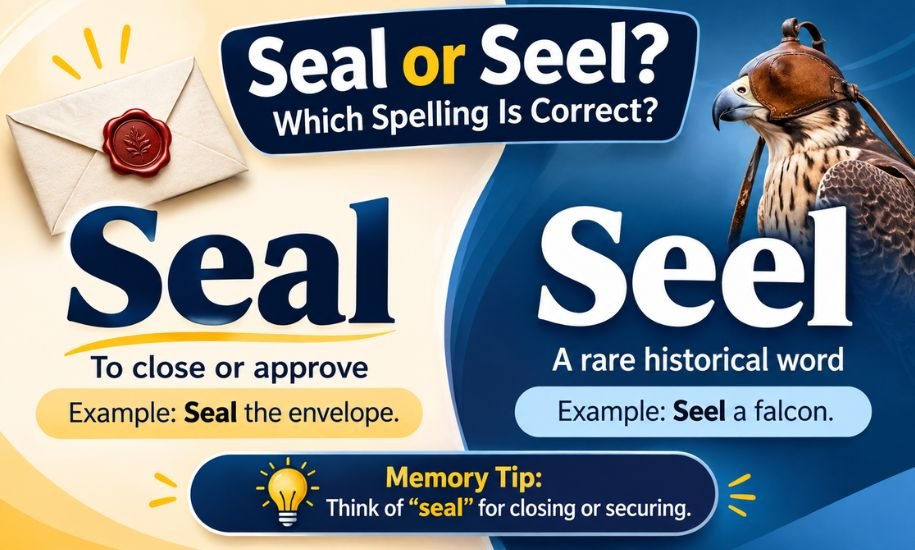
The words seal and seel sound alike, but they do not have the same meaning or everyday use. This can cause confusion when writing expressions such as “seal an envelope”, “seal the deal” and “seal of approval”. The good news is that the choice is straightforward in ordinary English: seal is the correct word in all these expressions. However, seel is not entirely made up; it has a rare, historical meaning connected with falconry.
Seal is the correct spelling when you mean to close an envelope, make an agreement final, give approval or refer to the marine animal. Seel is a genuine but extremely rare, archaic word associated with closing a bird of prey’s eyelids. It is not an alternative spelling of seal in everyday English.
Seal or Seel: What’s the Difference?
The main difference is their meaning and usage. Seal is a familiar modern English word that works as both a noun and a verb. Seel is an obsolete or specialised verb found mainly in historical references to falconry.
| Feature | Seal | Seel |
|---|---|---|
| Correct word in everyday English? | Yes | No |
| Part of speech | Noun and verb | Verb |
| Main meaning | To close securely; an official mark; a marine animal | To close or sew shut a bird’s eyelids |
| Typical usage | Letters, containers, agreements and approval | Historical falconry |
| Example | Please seal the envelope. | A historical text describes seeling a falcon. |
For ordinary writing, choose seal. The alternative only belongs in a specialised historical context where its unusual meaning is intended.
What Does Seal Mean?
Seal has several established meanings. As a verb, it generally means to close something securely, prevent it from opening or leaking, or make an arrangement official and final.
As a noun, it can refer to an official mark, a device or material that prevents something from opening or leaking, or a marine mammal.
Common meanings of seal include:
- To close something: To fasten an envelope, package or container securely.
- To finalise an agreement: To complete a deal or arrangement.
- To approve something: To give formal or recognised acceptance.
- An official mark: A stamp or emblem showing authority or authenticity.
- A marine animal: A mammal that lives in the sea and comes onto land or ice.
Here are some examples:
- Please seal the envelope before sending the letter.
- The two businesses finally sealed their agreement.
- The product carries an official seal of approval.
- We spotted a seal resting on the rocks near the beach.
- Make sure the lid is tightly sealed to prevent leaks.
The word also has related forms, including seals, sealed, sealing and sealable. For example, “She sealed the package” uses the past tense, while “He is sealing the box” uses the present participle.
Is Seel a Real Word?
Yes. Although it is rarely used in modern English, seel is a genuine historical word.
Its specialised meaning comes from falconry, the practice of training and handling birds of prey. Historically, to seel a hawk or falcon meant to close or sew together its eyelids. This practice was associated with keeping the bird’s eyes covered during certain stages of handling and training.
The word has also been recorded in older English with meanings connected to closing or blinding the eyes. These uses are now archaic and are unlikely to appear in ordinary conversation or modern writing.
For example:
- A historical falconry account described the practice of seeling a hawk.
- The old text used seel to refer to closing a bird’s eyelids.
Therefore, it would be inaccurate to say that seel does not exist. It does exist, but its specialised historical meaning does not make it a suitable substitute for seal.
Seal or Seel an Envelope?
The correct expression is seal an envelope.
It means to close the envelope by fastening its flap, usually with adhesive, so that the contents remain inside. This is the standard spelling in both British and American English.
Correct examples:
- Please seal the envelope before putting it in the post.
- She used a little adhesive to seal the letter.
- Remember to seal the envelope securely before sending it.
Incorrect: Please seel the envelope before posting it.
The mistake usually comes from writing the word according to its sound rather than remembering its established spelling.
Seal or Seel the Deal?
The correct expression is seal the deal.
This idiom means to complete an agreement, secure a transaction or bring negotiations to a successful conclusion. It is commonly used in business and everyday conversation.
Examples:
- The final meeting helped the companies seal the deal.
- Her excellent presentation was enough to seal the deal.
- Both parties hope to seal the deal before the end of the month.
Incorrect: The final meeting helped the companies seel the deal.
The expression always uses seal, not seel. It refers figuratively to making an agreement final rather than physically closing an object.
Seal or Seel of Approval?
The established expression is seal of approval.
It describes an indication that a person, organisation or authority accepts, supports or considers something satisfactory. It can also refer to an official mark showing that a product meets particular standards.
Examples:
- The proposal received the manager’s seal of approval.
- The product carries a recognised seal of approval.
- Her parents gave the wedding plans their seal of approval.
You may also encounter the expression stamp of approval, which has a similar meaning.
Incorrect: The new proposal received a seel of approval.
Remember that the noun seal refers to the mark or indication of acceptance. The historical verb seel has no role in this expression.
How to Remember the Correct Spelling
A simple way to remember the difference is to associate seal with closing or securing something.
Think of these familiar expressions:
- Seal a letter.
- Seal a package.
- Seal the deal.
- Seal of approval.
They all use the same spelling.
You can also connect the word to a physical seal, such as the closing on a bottle or a wax mark on a document. Both help reinforce the correct spelling.
Reserve seel for its rare historical falconry meaning. Unless you are discussing that specialist subject, seal is the word you need.
Frequently Asked Questions
1. Is seal or seel the correct spelling?
Seal is the correct spelling in ordinary English. Use it when closing an envelope, making an agreement final, referring to an official mark or describing the marine animal. Seel is a rare historical word with a specialised meaning in falconry.
2. Is seel a real English word?
Yes. Seel is a genuine but obsolete or highly specialised English verb. It historically referred to closing or sewing together the eyelids of a hawk or falcon. It is not an accepted alternative spelling of seal in everyday writing.
3. Do you seal or seel an envelope?
You seal an envelope. The verb means to close its flap securely, usually by using adhesive. Writing seel an envelope is incorrect in standard modern English.
4. Is it seal or seel the deal?
The correct idiom is seal the deal. It means to complete an agreement, finalise a transaction or secure a successful result. The spelling seel the deal is incorrect.
5. Is it seal or seel of approval?
The correct expression is seal of approval. It refers to an indication of acceptance, support or official recognition. Use seal, not seel, in this phrase.
6. Are seal and seel pronounced the same?
Yes, they are generally pronounced alike, with the long ‘ee’ sound found in words such as feel and heel. Their similar pronunciation does not make their meanings interchangeable.
Final Verdict: Seal or Seel?
For everyday English, seal is the spelling to remember. Use it to close an envelope, secure a package, finalise an agreement or describe a seal of approval. Although seel has a genuine historical meaning connected with falconry, it is not a replacement for the modern word. Grammar Stone aims to make distinctions like this easier to understand, helping you choose the right word and write with confidence.