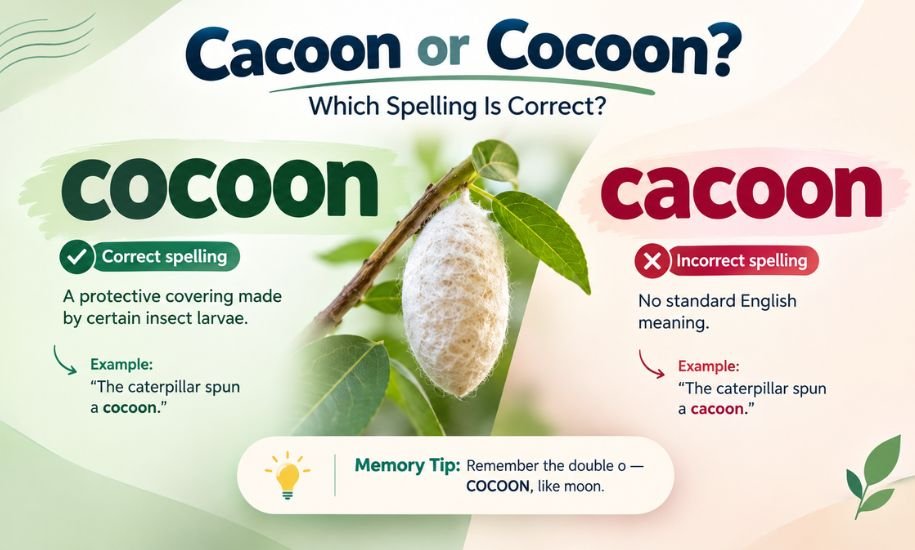
When writing about an insect’s protective covering or describing a comfortable, sheltered environment, the correct spelling is usually cocoon. However, cacoon is not entirely meaningless: it is a rare English noun with a separate botanical definition. The two words are therefore not interchangeable, even though their spellings look similar. Understanding their meanings will help you choose the right form, avoid an unnecessary spelling mistake and use the word correctly in everyday writing.
Use cocoon when referring to the protective covering made by certain insects or a safe, comfortable environment. Cacoon is also a recognised but very rare English noun referring to a large bean from a tropical climbing plant. It is not an alternative spelling of cocoon.
Cacoon or Cocoon: What Is the Difference?
The main difference is their meaning and usage. Although both spellings exist in dictionaries, cocoon is the word used in ordinary writing about insects, protection and comfortable surroundings.
A cocoon can describe a physical covering that protects an insect during development. It can also refer to a figurative place where someone feels safe and sheltered.
Cacoon, on the other hand, has a specific botanical meaning. It refers to the large bean of a tropical climbing plant called Entada scandens.
| Feature | Cocoon | Cacoon |
|---|---|---|
| Recognised English word | Yes | Yes, rarely used |
| Main meaning | Protective insect covering | Large tropical bean |
| Part of speech | Noun and verb | Noun |
| Figurative meaning | Yes | No established equivalent |
| Everyday usage | Common | Very rare |
| Correct for an insect covering | Yes | No |
The important point is that neither spelling should automatically be treated as a variation of the other.
What Does Cocoon Mean?
Cocoon is a noun that commonly describes a protective covering made from silk or similar materials by certain insects, particularly moths. It surrounds the developing insect and provides protection during an important stage of its life cycle.
For example, some moth caterpillars spin silk around themselves before entering the pupal stage. The adult moth eventually emerges after development is complete.
The word also has a figurative meaning. It can describe a peaceful, protected or comfortable environment that keeps someone away from outside difficulties.
Examples of Cocoon as a Noun
Here are some natural examples:
- The caterpillar spun a delicate cocoon around itself.
- The moth remained inside its cocoon while developing.
- She enjoyed the warm cocoon of her family home.
- Thick blankets created a comfortable cocoon around the sleeping child.
In the first two sentences, the word has its biological meaning. In the remaining examples, it describes a feeling of safety and comfort.
Cocoon as a Verb
Cocoon can also function as a verb. It means to surround or protect someone or something completely, often by creating a sheltered environment.
Its past-tense and past-participle forms are cocooned, while its present participle is cocooning.
Examples:
- She cocooned herself in a warm blanket.
- The children were cocooned from the outside world.
- He spent the evening cocooning at home.
- We felt warm and protected, cocooned inside our sleeping bags.
The verb is particularly useful when describing physical protection or a person’s decision to stay somewhere comfortable and sheltered.
Is Cacoon a Real English Word?
Yes. Although it is frequently mistaken for a spelling error, cacoon is a recognised English noun.
According to Collins English Dictionary, it refers to the large bean of a tropical climbing plant, Entada scandens. The bean has traditionally been used to make items such as purses, spoons and snuffboxes.
However, this meaning is uncommon in everyday communication. Most readers will encounter the word cocoon when discussing insect development or describing a protected environment.
Consider these examples:
- The naturalist identified the cacoon bean from a tropical climbing plant.
- Historical accounts describe the use of cacoon beans in making decorative objects.
These examples use the rare botanical meaning rather than referring to an insect’s protective covering.
Therefore, it would be inaccurate to claim that cacoon is never a real word. The important distinction is that it cannot replace cocoon in ordinary biological or figurative contexts.
Cocoon vs Chrysalis: Are They the Same?
The words cocoon and chrysalis are related to insect development, but they do not describe exactly the same thing.
A cocoon is a protective covering, usually made of silk, that certain insects construct around themselves. It is particularly associated with moths.
A chrysalis is the pupal stage of a butterfly. Unlike a moth pupa enclosed in a silk cocoon, a butterfly chrysalis is generally exposed rather than surrounded by a separate silk covering.
A pupa is the developmental stage between the larval and adult stages of an insect. Chrysalis is the specific term used for a butterfly pupa.
| Term | Meaning |
|---|---|
| Cocoon | A protective covering made by certain insects |
| Chrysalis | The pupal form of a butterfly |
| Pupa | The developmental stage between larva and adult |
For example:
- The moth caterpillar formed a silk cocoon.
- The monarch butterfly developed inside a green chrysalis.
- The insect remained in its pupal stage before emerging as an adult.
One useful distinction is that not every moth makes a cocoon. Some pupate without constructing this additional covering.
How Do You Pronounce Cocoon?
The British and American pronunciations of cocoon are the same in standard dictionary transcriptions:
IPA: /kəˈkuːn/
The word has two syllables, with the emphasis on the second. The first vowel is an unstressed schwa sound, while the second syllable contains a long ‘oo’ sound.
The unusual spelling can sometimes make readers hesitate, but the pronunciation becomes straightforward once the syllables are recognised.
The rare botanical word cacoon has a different initial vowel in its Collins dictionary transcription: /kæˈkuːn/.
Is the Spelling Different in British and American English?
No. Cocoon is the standard spelling in both British and American English.
Unlike pairs such as colour and color or centre and center, there is no standard British-American spelling difference here.
You should write cocoon when discussing:
- An insect’s protective covering.
- The development of certain moths.
- A comfortable or protected environment.
- Someone being surrounded by something that offers protection.
Cacoon retains its separate rare botanical meaning rather than serving as a regional spelling variation.
Examples of Correct Usage
The following examples show how to use both words in their appropriate contexts.
Correct uses of cocoon:
- The silkworm produced a protective cocoon.
- The moth emerged from its cocoon after completing its development.
- She wrapped herself in a blanket and created a cosy cocoon.
- The children grew up in a protective family environment.
- He cocooned himself indoors during the cold winter evenings.
Incorrect uses when referring to an insect covering:
- Incorrect: The caterpillar spun a cacoon.
- Correct: The caterpillar spun a cocoon.
- Incorrect: The moth emerged from its cacoon.
- Correct: The moth emerged from its cocoon.
Correct botanical use:
The botanist identified the cacoon bean as a seed from a tropical climbing plant.
This final example demonstrates why the rare word should not simply be dismissed as a spelling error.
An Easy Way to Remember the Correct Spelling
A simple way to remember cocoon is to associate its two consecutive letter o characters with the rounded, enclosed shape of a protective covering.
Think of a caterpillar surrounded by a silky cocoon. Whenever you describe this protective structure, remember the spelling with two consecutive o’s.
You can also remember the difference through their meanings:
- Cocoon: Think of a covering, comfort or protection.
- Cacoon: Think of the rare tropical bean.
This simple distinction should help you avoid confusing the two words in everyday writing.
Frequently Asked Questions
1. Is cacoon a misspelling of cocoon?
When someone intends to describe an insect’s protective covering, cacoon is the wrong spelling and cocoon should be used. However, cacoon is independently recognised as a rare botanical noun, so it is not universally an incorrect word.
2. What is the meaning of cocoon?
A cocoon is a protective covering made by certain insects, particularly moths, during their development. Figuratively, it can describe a safe, comfortable or sheltered environment. The word can also function as a verb meaning to surround or protect someone or something.
3. Can butterflies make cocoons?
Butterflies generally develop inside a chrysalis rather than a separate silk cocoon. Some moth caterpillars spin silk coverings before pupation. The chrysalis is the butterfly’s pupal form, whereas a cocoon is an additional protective covering.
4. Is cocoon a noun or a verb?
Cocoon can be both. As a noun, it refers to an insect’s protective covering or a figuratively sheltered environment. As a verb, it means to surround or protect someone or something. Its past-tense form is cocooned.
5. Is cocoon the same in British and American English?
Yes. Both British and American English use the spelling cocoon. Neither variety uses cacoon as an alternative regional spelling for the insect-related word.
Final Verdict: Cacoon or Cocoon?
For everyday writing, cocoon is the correct choice when referring to an insect’s protective covering or a place of safety and comfort. Although cacoon has a genuine but uncommon botanical meaning, the two words cannot be used interchangeably. Remembering this distinction will help you write accurately. At Grammar Stone, we believe that understanding a word’s meaning is just as important as remembering how to spell it.