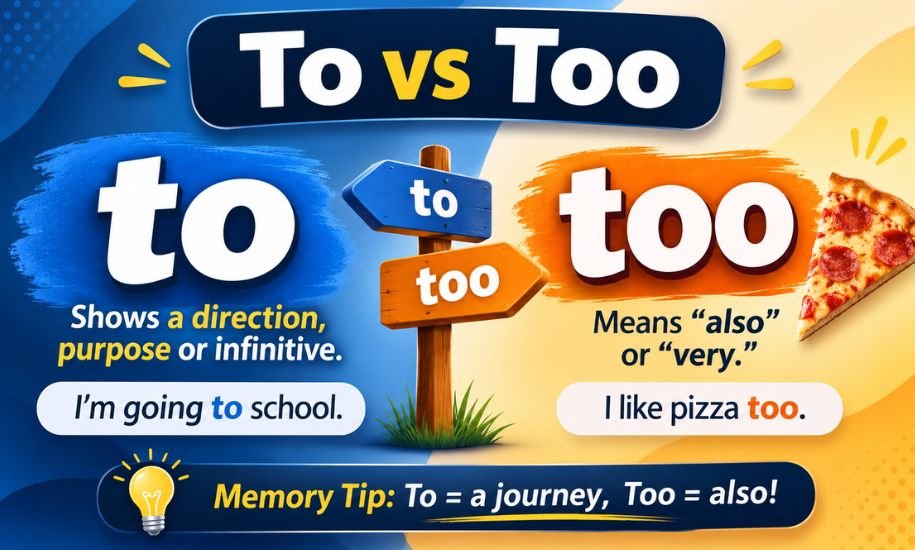
Have you ever hesitated between writing to and too? These two words are easy to confuse because they sound alike in many situations, but their meanings and grammatical functions are different. One is used to indicate direction, relationships or an intended action, while the other means also or more than necessary. Using the wrong one can change the meaning of a sentence. The good news is that a few simple rules and examples make it much easier to choose the correct word.
To is a preposition used for direction, relationships and recipients, and it also introduces the infinitive form of a verb, as in “I want to learn.” Too is an adverb meaning “also” or “more than necessary”, as in “I want to come too” and “The coffee is too hot.” Both spellings are correct, but they are not interchangeable.
To vs Too: What Is the Difference?
The main difference is their meaning and grammatical role. Although both words can sound identical, they perform different jobs in a sentence.
| Feature | To | Too |
|---|---|---|
| Part of speech | Preposition or infinitive marker | Adverb |
| Main meanings | Direction, relationship or an intended action | Also or excessively |
| Typical use | Going to school; wanting to learn | Coming too; too expensive |
| Example | She wants to travel. | She wants to travel too. |
Use to when referring to a destination, recipient, relationship or verb in its infinitive form. Choose too when you mean something applies as well or exceeds a suitable amount or degree.
For example:
- I am going to the library. (Destination)
- I am going too. (Also)
The spelling depends on what you want to communicate, not simply where the word appears in the sentence.
What Does To Mean?
To has two important grammatical functions: it works as a preposition and as an infinitive marker.
1. To as a preposition
A preposition establishes a relationship between words, often involving direction, destination, time or the person receiving something.
Direction or destination:
- We drove to Manchester yesterday.
- She walked to the nearest station.
- The children ran to their parents.
Showing a recipient:
- I gave the documents to my manager.
- Please send this message to Sarah.
- He handed the keys to his brother.
Showing time or a range:
- The office is open from Monday to Friday.
- It is ten minutes to six.
- The temperature increased from 10 to 20 degrees.
In each example, the word connects different parts of the sentence and explains their relationship.
2. To as an infinitive marker
To also appears before the base form of a verb to create a to-infinitive.
Examples:
- I want to improve my writing.
- She hopes to become a teacher.
- They decided to leave early.
- He needs to finish his homework.
- We plan to visit Scotland.
In these sentences, to introduces an action. It does not indicate a physical destination.
One useful grammatical detail is that some expressions contain to before a noun or an -ing form rather than an infinitive. For example, in “I look forward to meeting you”, to is a preposition, so it is followed by meeting.
What Does Too Mean?
Too is an adverb with two main meanings. It can express addition or indicate that something exceeds a suitable or desirable degree.
1. Too meaning also
When too means also or as well, it shows that something applies to another person or situation.
Examples:
- I would like to join the trip too.
- My sister enjoys reading too.
- They are attending the meeting too.
- He bought a new laptop, and I bought one too.
In this sense, the word often appears at the end of a sentence or clause.
You can frequently replace it with also or as well without changing the basic meaning.
For example:
- I want to participate too.
- I also want to participate.
- I want to participate as well.
All three sentences communicate that the speaker wants to participate in addition to someone else.
2. Too meaning excessively
The second meaning describes something that exceeds an acceptable, necessary or desirable amount or degree.
Examples:
- The water is too cold.
- This suitcase is too heavy.
- The food is too spicy for me.
- She is driving too quickly.
- The tickets are too expensive.
Here, too does not simply mean very. It suggests that something has gone beyond a suitable limit.
Compare:
- The room is very warm. (It has a high temperature.)
- The room is too warm. (It is warmer than is comfortable or desirable.)
This distinction is particularly important when choosing between the two expressions in everyday writing.
To and Too in Sentences: Practical Examples
Looking at the words side by side makes their different meanings easier to recognise.
| Sentence with to | Sentence with too |
|---|---|
| I want to sleep. | I am too tired. |
| She went to school. | She went to school too. |
| He needs to practise. | He practises too much. |
| We travelled to London. | We enjoyed London too. |
| I have to work. | I have too much work. |
| Give the book to John. | John wants one too. |
| She hopes to win. | She is too nervous. |
| They need to leave. | They are too busy. |
Examples where both words appear together
A sentence can contain both spellings because each has a separate grammatical function.
Consider these examples:
- I am too tired to cook dinner.
- She is too busy to attend the meeting.
- He wants to visit London too.
- The box is too heavy to carry.
- It is never too late to learn.
In the first sentence, too indicates an excessive level of tiredness, while to introduces the action of cooking.
Recognising the function of each word is more reliable than trying to remember its position.
Understanding the Too…to Grammar Pattern
The structure too + adjective or adverb + to + base verb is used to describe an excessive degree that makes an action impossible or unsuitable.
Examples:
- The tea is too hot to drink.
- She is too young to drive.
- The box is too heavy to lift.
- He was too exhausted to continue.
- The road is too narrow to accommodate two cars.
You can also include a person or thing using for:
- The tea is too hot for me to drink.
- The suitcase is too heavy for Sarah to carry.
- The question was too difficult for him to answer.
Too…to vs So…that
The two constructions can express a similar idea, although their grammatical structures are different.
| Too…to | So…that |
|---|---|
| The water is too cold to swim in. | The water is so cold that I cannot swim in it. |
| He was too tired to work. | He was so tired that he could not work. |
| The bag is too heavy to lift. | The bag is so heavy that I cannot lift it. |
| She is too young to drive. | She is so young that she cannot drive. |
Notice that the so…that construction commonly uses a negative clause to communicate the inability expressed by the original sentence.
To vs Too vs Two
There is another word worth understanding alongside these two: two. All three are commonly confused because they are pronounced alike when to receives its strong form.
However, their meanings are different.
| Word | Meaning | Example |
|---|---|---|
| To | Direction, relationship or infinitive marker | I want to learn. |
| Too | Also or excessively | I want to learn too. |
| Two | The number 2 | I have two books. |
Consider this sentence:
“I want to buy two books too.”
Each word has a separate function:
- To introduces the action of buying.
- Two tells us how many books.
- Too means that the speaker wants them as well.
This is a useful example to remember all three spellings.
How to Remember the Difference
A simple memory trick can help you choose the right spelling.
To has one O: Think of direction or an action you intend to take.
- I want to travel.
- She went to work.
Too has an extra O: Think of something extra, added or excessive.
- I want to travel too. (Added participation)
- The journey is too long. (Excessive length)
You can also try replacing too with also or excessively. If the sentence still makes sense, too is probably the right choice.
For example:
- I want to come also. (I want to come too.)
- The coffee is excessively hot. (The coffee is too hot.)
This quick substitution test works for the two main meanings of the word.
Common Mistakes to Avoid
Even familiar words can cause errors when writing quickly. Here are some common mistakes and their corrections.
| Incorrect | Correct |
|---|---|
| I want too visit London. | I want to visit London. |
| She is going too school. | She is going to school. |
| It is to cold outside. | It is too cold outside. |
| I love chocolate to. | I love chocolate too. |
| He has to many books. | He has too many books. |
| The coffee is to hot. | The coffee is too hot. |
Pay particular attention to expressions such as too much and too many.
Use too much with uncountable nouns:
- There is too much sugar in the tea.
- We have too much work today.
Use too many with plural countable nouns:
- There are too many people in the room.
- She has too many appointments.
The word too remains unchanged in both expressions.
Frequently Asked Questions
1. Are both to and too correct English words?
Yes. Both are standard English words, but they have different grammatical functions. To is a preposition or infinitive marker, while too is an adverb meaning also or excessively. Neither spelling is incorrect by itself; the correct choice depends on the sentence.
2. Are to and too pronounced the same?
They can sound identical. Both have the strong pronunciation /tuː/. However, to frequently has a weaker pronunciation in natural speech, such as /tə/, depending on the accent and sentence. This is why context is important when distinguishing them.
3. Is it too much or to much?
Too much is correct when describing an excessive quantity or degree. For example, “There is too much traffic today.” The spelling to much is incorrect in this expression.
4. Is it too late or to late?
The correct expression is too late. Here, too means later than is suitable or desirable. For example, “We arrived too late to catch the train.” The alternative to late is incorrect.
5. Should there be a comma before too?
Not usually when too simply means also at the end of a sentence. For example, “I would like to attend too” does not need a comma. When it interrupts a sentence, commas can set it apart: “I, too, would like to attend.”
Final Verdict: To or Too?
The distinction comes down to meaning. Use to for direction, relationships, recipients and infinitive verbs. Use too when you mean also or more than necessary. Remembering that the extra O suggests something extra can help you avoid many common mistakes. With these straightforward rules and examples, choosing the correct spelling becomes easier. Grammar Stone aims to make English grammar clearer through practical explanations that help you write with greater confidence.