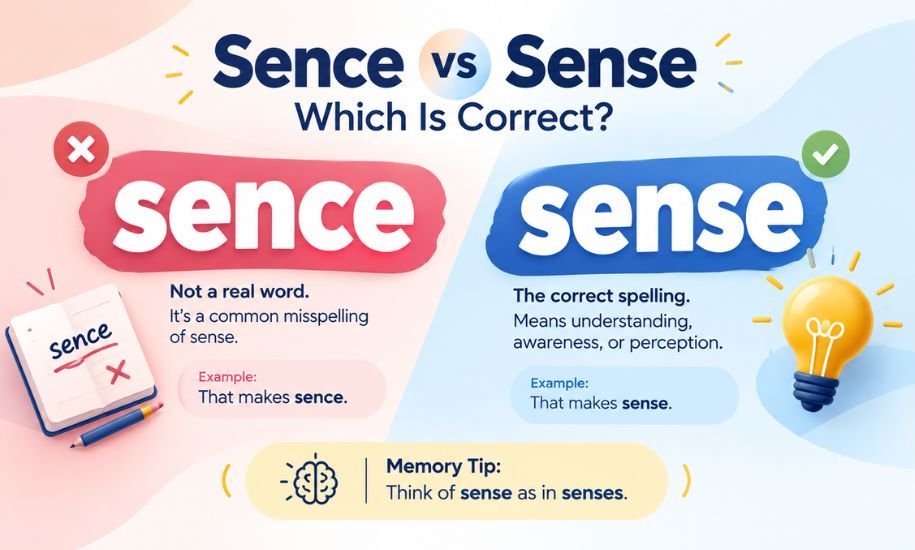
Have you ever wondered whether to write sence or sense? The two forms look almost identical, which makes the mistake easy to overlook when typing or writing quickly. However, only one is the standard spelling in modern English. The correct word is sense, which can describe understanding, good judgement, awareness or one of the five physical senses. Although sence appears in some historical records, it is not an accepted alternative in everyday modern writing. Understanding the correct spelling will help you avoid mistakes in common expressions and sentences.
Sense is the correct spelling in modern standard English. Sence is generally a misspelling and should not be used in ordinary writing. For example, write “It makes sense”, “common sense” and “sense of humour”, not their versions with a c.
Sence or Sense: What Is the Difference?
The main difference is that sense is a recognised modern English word, while sence is not a standard alternative spelling.
The word sense has several meanings. It can describe someone’s ability to make sensible decisions, understand information, recognise a feeling or experience the world through the five senses. It can also function as a verb meaning to notice or feel something.
Here is a quick comparison:
| Feature | Sense | Sence |
|---|---|---|
| Modern spelling | Correct | Incorrect |
| Meaning | Awareness, judgement or understanding | No standard modern meaning as an alternative to sense |
| Word type | Noun and verb | Not a standard modern form |
| British English | Accepted | Not accepted as a spelling of sense |
| American English | Accepted | Not accepted as a spelling of sense |
| Example | That makes sense. | That makes sence. |
There is no British or American spelling difference here. Both varieties use sense.
What Does Sense Mean?
Sense is a noun and a verb. Its exact meaning depends on the context in which it appears.
Sense as a Noun
As a noun, sense can refer to understanding, practical judgement, awareness, meaning or physical perception.
Consider these examples:
- Good judgement: You should use your common sense before making an important decision.
- Physical perception: Her sense of smell became stronger after recovering from a cold.
- Understanding: I finally made sense of the complicated instructions.
- Awareness: He has a strong sense of responsibility.
- Direction: My brother has a much better sense of direction than I do.
- Feeling: She had a sense that something was about to happen.
The word also appears in expressions such as sense of humour, sense of purpose and sixth sense.
Sense as a Verb
As a verb, sense means to notice, detect or become aware of something, sometimes without knowing exactly how.
Examples:
- I could sense that she was upset.
- The dog sensed danger and started barking.
- He sensed that something was wrong with the arrangement.
- She immediately sensed his disappointment.
In all these examples, the word describes noticing or feeling something.
Is Sence Ever a Real Word?
Although sence is not the correct spelling in modern standard English, it has appeared in historical language records.
The Dictionary of the Older Scottish Tongue records sence among the historical spellings associated with sense, with examples dating back to the sixteenth century. Historical records also include sence as a variant spelling of since.
These spellings belong to older forms of language and should not be confused with present-day standard usage.
Therefore, if you are writing an email, school assignment, article or professional document, use sense. The historical existence of an alternative spelling does not make it appropriate for ordinary modern English.
Is It Makes Sense or Makes Sence?
The correct expression is makes sense.
This phrase describes something that is logical, reasonable or easy to understand. It is commonly used in everyday conversations and formal writing.
Examples:
- Your explanation makes sense now.
- It makes sense to check the information before sharing it.
- Her decision makes perfect sense.
- Does this arrangement make sense to you?
- His argument does not make much sense.
The expression can also take different forms depending on the subject:
| Expression | Example |
|---|---|
| Make sense | These instructions make sense. |
| Makes sense | Your suggestion makes sense. |
| Made sense | His explanation made sense yesterday. |
| Making sense | The situation is finally making sense. |
| Make sense of | I cannot make sense of this document. |
Make sense of has a slightly different use. It means to understand something that may initially seem confusing.
For example:
- I am trying to make sense of the figures.
- She found it difficult to make sense of his explanation.
Writing make sence or makes sence is incorrect in both expressions.
Sense vs Since: Understanding the Difference
Another source of confusion is the difference between sense and since. Both are correctly spelled English words, but they have different meanings and grammatical uses.
Sense refers to understanding, awareness, judgement or perception.
Since generally refers to a point in time from which something has continued. It can also introduce a reason, meaning because or as.
Compare these examples:
| Word | Meaning | Example |
|---|---|---|
| Sense | Understanding | Your explanation makes sense. |
| Since | Time | I have lived here since 2022. |
| Since | Reason | Since it was raining, we stayed indoors. |
| Sense | Awareness of time | He has a good sense of time. |
The distinction becomes clearer when you look at complete sentences:
- Correct: I have not visited them since Monday.
- Correct: It makes sense to leave early.
- Correct: Since you are already here, you can join us.
- Incorrect: I have not visited them sence Monday.
- Incorrect: Your explanation makes sence.
Remember that sense of time describes someone’s awareness of time, whereas since can establish when an activity began or explain why something happened.
Common Expressions That Use Sense
The correct spelling appears in many everyday expressions. Learning these combinations can make it easier to recognise and remember the word.
| Expression | Meaning | Example |
|---|---|---|
| Common sense | Practical judgement | Use your common sense. |
| Sense of humour | Ability to understand and enjoy jokes | She has a wonderful sense of humour. |
| Sense of direction | Ability to find your way | I have a poor sense of direction. |
| Sense of smell | Ability to recognise smells | A dog has an excellent sense of smell. |
| Sense of purpose | Feeling that something has meaning | His work gives him a sense of purpose. |
| Sixth sense | A strong instinct or feeling | She had a sixth sense that something was wrong. |
| Fashion sense | Understanding of clothing and style | He has excellent fashion sense. |
| Sense of responsibility | Awareness of one’s duties | A good manager needs a sense of responsibility. |
Notice that none of these expressions uses sence. The spelling remains the same regardless of the phrase.
Synonyms of Sense
The word has several meanings, so its synonyms depend on the context.
| Intended meaning | Suitable synonyms |
|---|---|
| Good judgement | Wisdom, prudence, discernment |
| Awareness | Consciousness, perception |
| Understanding | Comprehension, knowledge |
| Feeling or intuition | Instinct, impression, hunch |
| Meaning | Significance, interpretation |
| Sense as a verb | Detect, notice, perceive |
For example, wisdom may replace sense in a sentence about good judgement, but it will not necessarily work when referring to one of the five physical senses.
Always choose a synonym according to the meaning of the original sentence.
How to Remember the Correct Spelling
A simple way to remember sense is to associate it with the word sensible.
Both words begin with sens, making the spelling easier to remember:
- Sense
- Sensible
- Sensibly
- Sensitivity
- Sensation
You can also remember the phrase common sense. Since this expression always uses an s, it provides a useful reminder when writing other combinations.
When proofreading, pay particular attention to expressions such as makes sense, sense of humour and sense of direction. These are places where the incorrect spelling can easily go unnoticed.
Frequently Asked Questions
1. Is sence a real word?
Sence appears in historical English and Scots records as an older spelling of sense and, in separate historical usage, as a variant of since. However, it is not an accepted alternative in modern standard English. Use sense in everyday and formal writing.
2. Is it makes sense or makes sence?
Makes sense is the correct expression. It means that something is logical, reasonable or understandable. For example, “Your explanation makes sense.” Writing makes sence is a spelling mistake.
3. How do you spell sense of humour?
The correct British English spelling is sense of humour. In American English, the usual spelling is sense of humor. The spelling of sense does not change between the two varieties.
4. What is the difference between sense and since?
Sense refers to understanding, awareness, judgement or perception. Since refers to a time starting point or introduces a reason. For example, “It makes sense” and “I have lived here since 2020” use the words differently.
5. What is the meaning of sense of time?
A sense of time is someone’s ability to understand or judge how much time has passed, how long something takes or when an event should happen. For example, “She has an excellent sense of time and is rarely late.”
6. What are some synonyms for sense?
Depending on the context, synonyms include wisdom, judgement, awareness, perception, understanding, instinct and significance. As a verb, sense can sometimes be replaced with notice, detect or perceive.
Final Verdict: Sence or Sense?
Sense is the correct spelling to use in modern standard English. It works as both a noun and a verb and appears in expressions such as common sense, makes sense and sense of humour. Although sence has historical uses, it should not replace the standard spelling in contemporary writing. Remember the correct form and keep your English clear with the practical spelling and grammar guidance from Grammar Stone.