The words begin and began have the same basic meaning: to start something. However, they are used in different grammatical situations. The difference comes down to tense. Begin is the base form of the verb, while began is its simple past form. There is also a third form, begun, which is used with helping verbs such as has, have and had. Understanding how these three forms work will help you choose the correct word and avoid common mistakes.
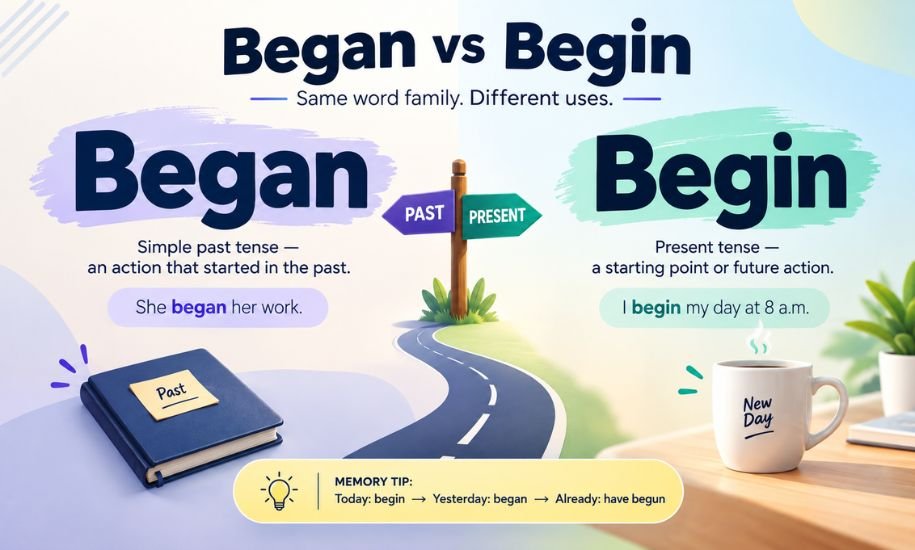
Both begin and began are correct. Begin is the base form of the verb, used for present situations and after words such as will, can and did. Began is the simple past form, used for something that started in the past. The past participle is begun, as in “The meeting has begun.”
Began vs Begin: What’s the Difference?
The main difference is the time and grammatical structure in which each word is used.
Begin is the base form of an irregular verb. It is used in the present simple with I, you, we and they, in infinitive constructions, and after modal verbs such as will, can and should.
Began is the simple past form. It describes an action that started at an earlier time.
Compare these sentences:
- I begin work at eight every morning.
- I began work at eight yesterday.
The first sentence describes a regular routine, while the second refers to a past event.
Here is a quick comparison:
| Feature | Begin | Began |
|---|---|---|
| Verb form | Base form | Simple past |
| Meaning | To start | Started |
| Main use | Present and other base-form constructions | Past events |
| After will | Will begin | Incorrect |
| After did | Did begin | Did began is incorrect |
| Example | We begin tomorrow. | We began yesterday. |
Neither word is inherently incorrect. The right choice depends on how the verb functions in the sentence.
What Does Begin Mean?
Begin means to start something, perform the first part of an activity or enter a new stage of an event or process.
It is an irregular verb, so its past form does not follow the usual pattern of adding -ed. The base form can appear in several grammatical constructions.
When to use begin
1. For present habits and routines
Use begin when describing regular activities with subjects such as I, you, we and they.
Examples:
- I begin my English lessons every Monday.
- We begin our meetings at nine.
- They begin their journey early in the morning.
With he, she or it, the correct present-tense form is begins.
- She begins work at seven.
- The programme begins at six o’clock.
2. After modal verbs
The base form follows modal verbs such as will, can, could, should and might.
Examples:
- The presentation will begin shortly.
- You can begin your assignment now.
- We should begin preparing for the event.
- The ceremony might begin earlier than planned.
Do not change the verb into its past form after a modal verb.
Incorrect: The meeting will began at ten.
Correct: The meeting will begin at ten.
3. After did and didn’t
When forming past-simple questions and negative sentences with did or didn’t, use the base form.
Examples:
- When did the film begin?
- Did the class begin on time?
- The meeting didn’t begin until noon.
- Why didn’t you begin your work earlier?
Although these sentences refer to the past, did already carries the past-tense marking. Therefore, the main verb remains begin.
4. With the infinitive
Use to begin when the verb functions as an infinitive.
Examples:
- She wants to begin a new course.
- It is never too late to begin again.
- We decided to begin the preparations early.
What Does Began Mean?
Began is the simple past form of begin. It means that an action started at some point in the past.
Use it when describing a starting event that has already happened. The activity itself does not necessarily need to be finished.
Examples:
- The concert began at seven last night.
- She began her career as a journalist.
- The weather began to change in the afternoon.
- My interest in photography began at school.
- They began building their new house last year.
- The discussion began shortly after lunch.
Notice that began can describe the starting point of an activity that is still continuing.
For example:
The company began developing the product last year and is still working on it.
The starting event happened in the past, so began is correct even though the development work has not finished.
What About Begun? Understanding All Three Forms
Begun is the past participle of begin. It is not interchangeable with began. It usually appears with helping verbs to form perfect tenses.
Understanding all three forms makes it much easier to choose the right word.
| Verb form | Example | Grammatical use |
|---|---|---|
| Begin | I begin my work. | Base form |
| Begins | She begins her work. | Present simple, third-person singular |
| Began | She began her work. | Simple past |
| Begun | She has begun her work. | Past participle |
| Beginning | She is beginning her work. | -ing form |
1. Has begun and have begun
Use has begun with he, she and it, or a singular subject. Use have begun with I, you, we and they, or a plural subject.
Examples:
- The meeting has begun.
- She has begun learning Spanish.
- They have begun their preparations.
- We have begun working on the new project.
2. Had begun
Use had begun when one past event started before another past event.
Examples:
- The film had begun before we reached the cinema.
- She had begun cooking when the guests arrived.
- The rain had begun before the match was cancelled.
3. Begun in passive constructions
The past participle can also appear in passive sentences.
Example:
The investigation was begun by a small team.
Although this construction is grammatically possible, an active sentence such as “A small team began the investigation” will often sound more natural.
It Began or It Has Begun: Which Is Correct?
Both expressions are grammatically correct, but they communicate time differently.
It began is the simple past form. Use it when referring to a starting event at a past time.
Examples:
- The event began yesterday.
- The story began in a small village.
- The rain began during the night.
It has begun is the present perfect form. Use it to connect a past starting event with the present, often when the fact that something has started is important now.
Examples:
- The event has begun, so please take your seats.
- A new chapter has begun.
- The examination has begun, and all candidates must remain seated.
The structure is simple:
- Simple past: subject + began.
- Present perfect: subject + has/have + begun.
Remember that has began and have began are incorrect in standard English because they use the simple past form instead of the required past participle.
Where It All Began or Where It All Begun?
The standard expression is “where it all began”.
It refers to the original place, moment or circumstances from which something started.
Examples:
- This is the town where it all began.
- We returned to the place where our friendship began.
- That small decision was where it all began.
The expression where it all begun is not standard in this construction. The reason is that begun is a past participle and normally needs an appropriate helping verb.
You could use begun in a different sentence containing a perfect-tense construction, such as:
This is where the process has begun.
However, when describing the original starting point of a story, relationship or journey, “where it all began” is the natural and established expression.
Common Mistakes with These Verb Forms
The confusion often happens when writers use the past form in a construction that requires the base form or past participle.
Here are some mistakes worth avoiding:
| Incorrect | Correct |
|---|---|
| I begin my course yesterday. | I began my course yesterday. |
| She will began tomorrow. | She will begin tomorrow. |
| When did the show began? | When did the show begin? |
| He has began reading. | He has begun reading. |
| They had began working. | They had begun working. |
| The story has began. | The story has begun. |
| Where it all begun. | Where it all began. |
| She begins her career in 2015. | She began her career in 2015. |
Three simple rules can help you avoid most of these errors:
- Use begin after will, can, should, did and similar constructions that require the base form.
- Use began for an action that started in the past.
- Use begun after has, have and had when forming perfect tenses.
How to Remember the Difference
A useful way to remember the three forms is to associate each one with its grammatical role:
Begin = Start
Use it as the base form.
I want to begin my studies.
Began = Started
Use it to describe a past starting event.
I began my studies last year.
Begun = Has or had started
Use it as a past participle with an appropriate helping verb.
I have begun my studies.
You can also remember the sequence:
Begin → Began → Begun
This is the correct progression of the verb’s base form, simple past and past participle.
Frequently Asked Questions
1. Is it began or begin?
Both are correct, but they are used differently. Begin is the base form, while began is the simple past. For example, “I begin work at nine” describes a routine, whereas “I began work at nine yesterday” describes a past event.
2. What is the past tense of begin?
The simple past tense of begin is began. For example, “The match began at three o’clock.” Its past participle is begun, as in “The match has begun.”
3. Is begun the same as began?
No. Both come from the verb begin, but they have different grammatical functions. Began is the simple past form, while begun is the past participle. You would say “She began yesterday” but “She has begun.”
4. Should I say it has begun or it has began?
The correct expression is “it has begun”. The present perfect requires has followed by the past participle, which is begun. “It has began” is incorrect in standard English.
5. Can I use begin after did?
Yes. Use the base form after did and didn’t, even when talking about the past. For example, “Did the meeting begin on time?” and “The meeting didn’t begin until ten” are both correct.
6. Is it where it all began or where it all begun?
“Where it all began” is the standard expression. It describes the original starting point of something. Begun normally needs a helping verb, such as has, have or had, so it does not fit this standalone expression.
Final Verdict: Began or Begin?
Both words are correct, but they are not interchangeable. Use begin for the base form of the verb, including present situations and constructions with modal verbs. Choose began when describing something that started in the past. When using has, have or had, remember the third form: begun. Learning this simple pattern will make your sentences more accurate and natural. Grammar Stone makes these distinctions easier to understand with clear explanations and practical examples.