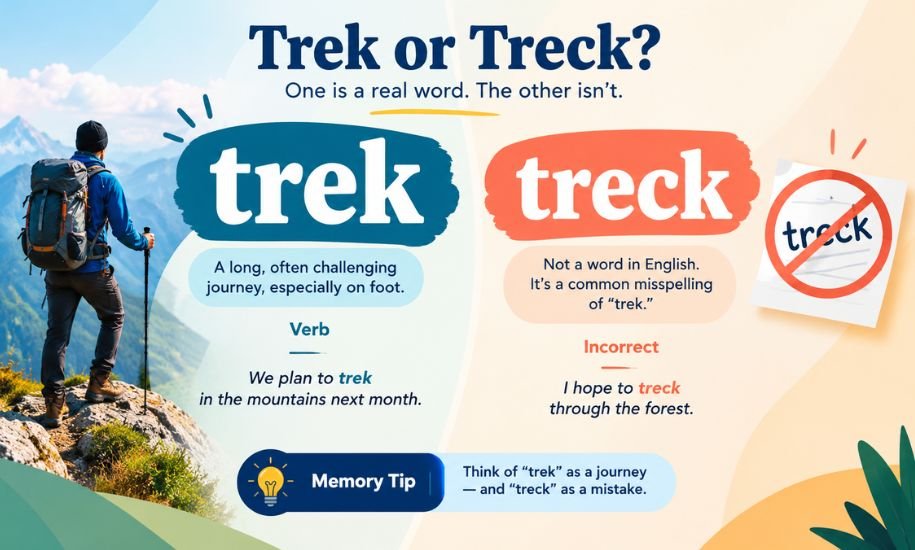
“Treck” and “trek” look almost identical, and the extra c can seem natural because English has many words ending in -ck. However, the standard spelling used in modern English is trek. It can be a noun for a long or difficult journey and a verb meaning to travel or walk a long distance, especially when the journey is tiring or demanding. The form treck is generally not the spelling you should use in modern writing, although historical sources do record it as an archaic form of trek.
Trek is the correct standard spelling in modern English. “Treck” is normally treated as a misspelling when you mean a long or difficult journey, although it is also recorded as an archaic historical form of trek. For everyday, academic, professional, and formal writing, use trek, trekked, and trekking.
Treck or Trek: Which Is Correct?
The answer is straightforward for modern English: trek is the form to use.
| Feature | Trek | Treck |
|---|---|---|
| Standard modern spelling | Yes | No |
| Common modern noun | Yes | No |
| Common modern verb | Yes | No |
| Correct forms | trek, trekked, trekking | Not recommended in modern writing |
| Historical use | Yes | Recorded as an archaic form |
| Best choice today | Use it | Avoid it |
Oxford lists trek as both a noun and a verb, with the forms treks, trekked, and trekking. Cambridge likewise gives trek as a noun and verb.
The important qualification is that “treck” is not completely imaginary. Wiktionary records it as an archaic English noun and verb meaning the same thing as trek. The Dictionary of South African English also records treck among earlier forms of trek.
So the most accurate modern rule is:
Use “trek” in contemporary English. Treat “treck” as an archaic or historical form rather than the normal spelling today.
What Does “Trek” Mean?
As a noun, trek refers to a long, difficult, or tiring journey. It is especially associated with walking through challenging terrain, although the word can also be used more generally for a journey that feels long or demanding.
Examples:
- The hikers began their trek before sunrise.
- They completed a three-day trek across the mountains.
- It is quite a trek from the station to the hotel.
As a verb, trek means to make a long or difficult journey, often on foot. Oxford also notes its use for spending time walking, particularly in mountains or for recreation.
Examples:
- We trekked across the valley before sunset.
- They plan to trek through the forest.
- She spent the summer trekking in Nepal.
The word does not always describe an extreme mountain expedition. In informal English, you can describe an ordinary but tiring journey as a trek. Cambridge, Oxford, and Collins all show this broader usage.
Is “Treck” a Real Word?
This question needs a little more care than simply saying “no.”
For modern standard English, treck is not the spelling you should choose when you mean a long or difficult journey. If you write, “We went on a long treck,” most readers will understand what you mean, but the standard form is:
We went on a long trek.
However, historical evidence shows that treck has existed as an archaic form of trek. Wiktionary specifically labels it as an archaic noun and verb, while the Dictionary of South African English records treck as an earlier form of trek.
That distinction matters. A historical spelling can be a genuine word form without being the spelling normally accepted in contemporary writing.
Therefore:
- Modern writing: use trek.
- Historical texts: you may encounter treck.
- Formal writing: trek is the safe standard choice.
Why Do People Write “Treck”?
The mistake is understandable because English spelling does not always make the /k/ sound predictable.
Words such as deck, neck, check, and wreck use -ck, so it is easy to see why someone might instinctively write treck. But the conventional spelling of the word is trek.
Pronunciation does not help much either. Trek is pronounced /trek/, so a listener cannot tell whether the writer is thinking of trek or mistakenly imagining treck. Cambridge and Oxford both give the pronunciation with the same short e sound.
A useful habit is to remember the basic word together with its common forms:
trek → trekked → trekking
Seeing the doubled k in the inflected forms can help reinforce the spelling.
Trek, Trekked, or Trekking?
One of the easiest ways to make a mistake is to add an ending incorrectly.
The standard forms are:
| Form | Correct spelling |
|---|---|
| Base form | trek |
| Third-person singular | treks |
| Past tense | trekked |
| Past participle | trekked |
| -ing form | trekking |
Oxford explicitly lists these verb forms.
Examples:
- She treks through the hills every summer.
- They trekked for six hours yesterday.
- We are trekking through the national park tomorrow.
Avoid forms such as trecked, trecking, or treked when writing modern standard English.
The doubled k in trekked and trekking is worth remembering because it prevents a common spelling problem. The base form remains trek, not treck.
Trek vs Hike vs Journey
These words overlap, but they are not always interchangeable.
Trek often suggests a long, difficult, or tiring journey. It can involve walking through mountains, forests, deserts, or other demanding terrain, but it can also describe an ordinary journey that feels unusually long.
Hike usually refers to walking, particularly for recreation or outdoors.
Journey is the broadest term. It can describe travel by foot, car, train, plane, or another form of transport and does not necessarily suggest difficulty.
Compare these examples:
- We went on a hike through the woods.
- They completed a difficult trek across the mountains.
- The journey from London to Edinburgh took several hours.
There is plenty of overlap, but trek tends to add a sense of distance, effort, or difficulty.
Is “Trek” British or American English?
Trek is used in both British and American English. It is not a case where one variety uses trek and the other uses treck.
Cambridge lists the word in both UK and US English, while Oxford provides standard English entries for both noun and verb uses.
So these are both correct:
- British English: We went on a long trek.
- American English: We went on a long trek.
The spelling does not change to treck in either variety.
Where Does the Word “Trek” Come From?
The history of trek helps explain why the word has such strong associations with travel.
Oxford traces it to South African Dutch, from trek as a noun and trekken as a verb meaning “pull” or “travel.” Collins similarly gives an origin through Afrikaans and Dutch.
The word also has an important historical South African sense connected with travel or migration by ox wagon. Collins records this meaning, and the Dictionary of South African English documents historical uses related to wagon travel and migration.
Today, however, you do not need to be describing an ox-wagon journey to use trek. Modern English has broadened the word considerably.
Common Mistakes With Trek
Here are some of the most useful corrections to remember:
Incorrect: We went on a long treck.
Correct: We went on a long trek.
Incorrect: They trecked across the valley.
Correct: They trekked across the valley.
Incorrect: She enjoys trecking in the mountains.
Correct: She enjoys trekking in the mountains.
Incorrect: The trip was a difficult trek?
Correct: The trip was a difficult trek.
The last example is correct because trek works naturally as a noun.
The easiest rule is simple: start with trek, and double the k when you add -ed or -ing.
Is “Treck” a Scrabble Word?
This is a different question from whether treck is standard modern English.
Word-game dictionaries can have different word lists. Merriam-Webster’s Scrabble Word Finder currently says TRECK is not a playable word, while the official Collins Scrabble word list includes TRECK.
So the answer depends on the specific Scrabble dictionary or word list being used.
For ordinary writing, however, Scrabble validity is not the deciding factor. The standard modern spelling remains trek.
Easy Way to Remember the Spelling
Think of the word as:
TREK = one K in the base word
Then remember its main verb forms:
TREK → TREKKED → TREKKING
You do not need to add a c to the base word.
A simple sentence to reinforce it is:
We trekked on a long trek.
Both forms use k, which makes the spelling pattern easier to remember.
Frequently Asked Questions
Is treck or trek correct?
Trek is the correct standard spelling in modern English. Treck may appear in historical contexts as an archaic form, but it is not the normal spelling to use today.
Is treck an old spelling of trek?
Yes. Historical sources record treck as an archaic form of trek. That does not make it the preferred spelling in contemporary English.
Is it trekking or trecking?
The standard modern form is trekking. The final k is doubled before -ing: trek → trekking.
Is it trekked or trecked?
Use trekked. The past tense and past participle of trek are both trekked.
Is trek an American or British word?
It is used in both British and American English. There is no British spelling treck versus American spelling trek.
Does a trek always mean a mountain hike?
No. A trek can describe a long or difficult walk, a demanding journey, or informally a trip that feels long or tiring. It does not have to take place in the mountains.
Final Verdict: Treck or Trek?
For modern English, choose trek. It is the standard spelling for the noun and verb, with the related forms treks, trekked, and trekking. Although treck has a documented historical life as an archaic form, it should not replace trek in normal contemporary writing. For clear and accurate English, trek is the spelling to remember—and that is the kind of practical distinction Grammar Stone aims to make easier.